
 Posted by
 TL;DR version: First do a small bet calculation to determine return on investment. If ROI is under 194.12%, set a bet at minimum stakes or greater that simultaneously holds this ROI and doesn’t breach the net gain limit for the number of pounds you are pledging. If ROI is slightly under 194.12%, consider adjusting your commitment in a way that drives the minimum bet ROI to >200%, shifting you into the better-paying supersize (or “triple-bonus) model.
For HealthyWagers, the Healthy Wage calculator has two distinct formulas for calculating net gain, return on investment (ROI) and the “prize.” One or the other in is effect for each bet you calculate.
This post describes what I call the “regular” formula. There is also a formula I am now calling the “triple-bonus” formula. (In the original version of this post I called it “supersize”—a nod to McDonalds—but triple-bonus is more descriptive so I’m going forward with that.)
The regular formula is generally in effect if you are clinically overweight or moderately obese (body mass index of 35 or less), and you are betting to lose only a few dozen pounds or so. The ROIs are between 11% and 194%—before boost enhancements, which are a (non-caloric) sweetener that you just take no matter what formula you are dealing with.
The “triple-bonus” formula is for more severely obese players who are trying to lose substantial amounts of weight. The ROI there is better than 200% across the range of investments you should be betting in. In that formula get your bet nearly tripled, plus a flat bonus that is independent of bet size. I discuss this in detail in another post.
Locating yourself within the regular formula
To find out if you are in the “regular” formula, calculate your bet with a $101 to $150 total investment for the number of months you want and the number of pounds you want. As you are required to enter investment on a monthly basis, use these values for convenience:
- 6 months: $20/month
- 7-10 months: $15/month
- 11-15 months: $10/month
- 16-18 months: $7/month
When the prize screen comes up, check out the ROI. If it is between 11% and 194.12%, you are in the regular formula of the calculator.
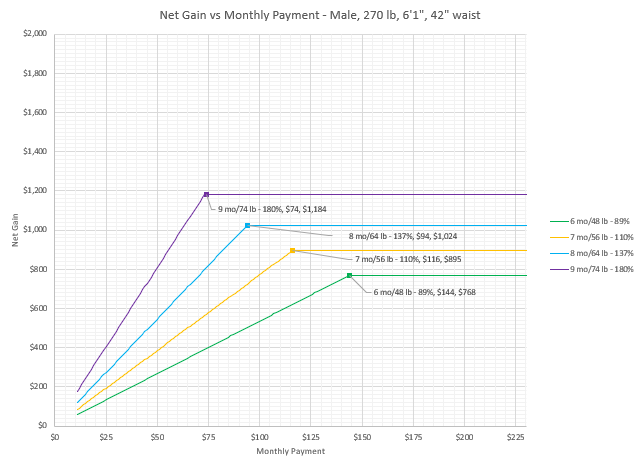
The ROI will stay the same as you increase your investment. If it’s 75%, for example, with every additional $100 you put in you will win that back plus another $75. Your net gain will increase by $75 and your prize by $175 (incremental gain plus incremental investment returned).
If it’s 100%, you can double the additional dollars you put in, and if it’s 150% you can earn 3 to 2 on them in net gain terms, or 5 for 2 in prize terms.
All of this is represented by the upward slopes in the chart above.
However, this constant ROI with increasing investment lasts only to a certain point. Beyond this point, net gain flatlines, and additional dollars put in only get pushed back to you when you win. Meanwhile, your ROI decreases with the additional dollars added.
These are the horizontal line in the chart. It represents the “sucker bet” region of the graph. You should never bet so much that you are on the red line on the graph—you can get the same amount of new cash out of Healthy Wage by betting less money.
If you go far enough out your net gain will start to drop $100 for every $100 additional invested—because you have idiotically slammed into the $10,000 prize limit.
So what defines the ROI in the slopes region and what defines the flatline level for net gain?
ROI definition
The ROI in the green region, including at minimum bets, is dependent on three biometric inputs to the calculator (sex, weight, and height) and the two bet definition elements of time and pounds pledged. The ROI is independent of monthly payment until that gets high enough for net gain to reach the flatline level.
(Note: Until recently, waist circumference was an input to the calculator that caused ROI to be suppressed if it made for too low a waist-to-height ratio. As of early September 2019 it is no longer a biometric input.)
I don’t know the exact formula for this ROI. With enough investigation it could be ferreted out, but that isn’t very important for practical purposes. You’re going to be going into the calculator and seeing what it spits out as you vary the inputs.
What is important is how the ROI changes as the five inputs that affect it change—what changes make it go up or down. Also, if the ROI is manipulated to rise above 194.12%, the calculator shifts to the “triple-bonus” formula, which is something you want if you can get it because it pays out significantly better than the regular formula.
ROI and biometric inputs
Here is how the ROI changes with different biometric inputs:
- ROI seems to be higher for women than for men of similar size, all else being equal
- ROI rises sharply with body mass index (BMI), which is a metric proportional to weight divided by height squared.
- (Before September 2019, ROI was unaffected by waist circumference unless the ratio of waist circumference to height was less than about 0.6—in which case the ROI decreased. Healthy Wage removed it from the calculator interface—in my opinion, because it had little effect on the bets overall and the extra confusion and doubt it caused was not worth the benefit of having it in there.)
Generally you cannot improve ROI substantially by manipulating biometric data. Sex and height are almost impossible to change. And although gaining weight can raise the ROI, the costs of doing that are usually not worth the effort.
ROI and wager contractual inputs
Here is how the ROI changes as you adjust the parameters that define what you are committing to do and in what amount of time:
- ROI increases slightly when time (number of months) increases with number of pounds staying the same—but it’s small enough that the ROI per month is actually less.
- ROI increases more substantially when number of pounds increases with time staying the same
- ROI increases the most when pounds and time are increased together
In case 1, although the rate of weight loss per unit of time is less, you are doing weight loss for a longer period. Perhaps Healthy Wage thinks stamina trumps sprinting and has therefore offered a better ROI with more time.
Case 2 is more intuitive.
Case 3 represents the additive effect of the first two cases. The rate of weight loss per unit of time can be held constant while pounds and time are proportionally increased. Healthy Wage will reward sustaining a weight loss regimen for longer periods of time.
Net gain plateau and biometric inputs
The primary factor that affects the net gain plateau level is sex. Disregarding the possible effects of BMI as discussed in the next paragraph, the net gain flatline is simply $16 per pound pledged for men and $30 per pound pledged for women. A man losing 40 pounds in the regular formula will have a maximum net gain available of $640 while a woman losing 40 pounds can make up to $1,200 net gain.
For women at lower levels of BMI (33 or less), there is a further lowering of the net gain ceiling that may supersede the $30 per pound ceiling that is generally in effect:
- If your BMI is 29.6 or less, your ceiling will be no higher than $800. This will affect you if you pledge to lose 27 or more pounds—the $800 from the BMI dependent limit is lower than the $810 resulting from multiplying 27 pounds by $30.
- For higher BMIs, the BMI limit on net gain is higher and rises linearly with BMI. To find it, multiply BMI by $500 and subtract $14,000 from that product, and round that total to the nearest $5.
- As a quick reference, a BMI of 30 imposes a BMI dependent net gain ceiling of $1,000, which you’ll feel if you pledge to lose 34 pounds. A BMI of 30.78 yields a BMI dependent limit of $1,390, which is significant for pledges of 47 pounds or greater.
Net gain plateau and wager contractual inputs
The pounds pledged is multiplied by $16 for men or $30 for women to obtain the plateau, subject to an additional maximum constraint for low BMI people.
How to apply all of this to your bet
Important note: The following discussion assumes that you did your research beforehand on whether you can actually perform the obligation you are about to take on. If you haven’t done this, go back and do that work first, and then come back to the calculator. Otherwise, all of this will be an academic exercise for you. “You got this!” isn’t going to carry the freight here.
First, do the near minimum-bet calculation described above in “Locating yourself within the regular formula” up-post.
If the ROI is between 50% and 160%, you are probably going to be in a HealthyWager defined by the regular formula. See down-post for what to do if the ROI is outside of this range in either direction. For ROIs within this range, read on.
If you want to make a minimum or near minimum bet, you are about done. Calculate with the exact amount and make the bet (applying the referral code, of course!)
If you want to make a large bet, you need to find the net gain plateau so you know what investment amount not to exceed. Usually this is the net gain plateau divided by the ROI you calculated, and divided again by the number of month to get the monthly payment.
If you calculate a bet with this monthly payment, you should get back a gain approximately equal to the plateau and an ROI the same or almost the same as the first ROI.
If you get back a lower plateau and lower ROI, you may have the upper constraint for low BMI situations in effect, and you will have to redo the calculation—this time dividing that lower plateau by the ROI and then again by the number of months.
You can now set a bet from anywhere between the minimum monthly payment allowed and the maximum you just found.
For ROI under 50%: Consider doing a minimum payment with the best promo boost you can find. Then do concurrent 12-week mini challengers (6% weight loss in 12 weeks) at Healthy Wage, and possibly transformers at DietBet if you want to use that service as well. The returns on minis and transformers on a per-month basis are going to be better than for a large HealthyWager with low ROIs like this.
For ROI above 160%: This is a very good ROI, but go back and think about adding a few pounds, or adding pounds and time. If you can do this, you may be able to shift into the triple-bonus formula, which offers better than a triple on your money generally.
Examples to be posted in the coming days…
 Weight Betting Odds
One comment