
 Posted by
 This weekend I believe I have discovered the full set of equations that tell you what you need to bet to obtain the maximum amount of Healthy Wage money in a HealthyWager.
Before I dive into this, I will point out that I still need to find the equations for return on investment for what I call the “regular” net gain formula. Specifically, I want to predict how much weight loss you have to pledge (either in pounds or percentage) to drive the ROI high enough to trigger what I am now calling the “triple-bonus” net gain formula.
It is complex, but I did see some trends that need further investigation. For instance, it seems that the higher your starting body mass index (BMI), the lower the percentage of weight you need to lose to trigger the triple-bonus formula. They want to pay the obese people more handsomely than the merely overweight people.
The relative generosity toward the obese is also present in the increased maximum net gain “plateaus” that are afforded to those who pledge to lose lots of weight, and who have a lot of excess weight to lose as judged by the BMI metric.
Read on and I will explain.
Five-step procedure for maximum gain
For every HealthyWager weight pledge you can make–number of pounds and amount of time; with height, weight, and gender indicated–there will be one of two formulas that will define how much net gain and return on investment (ROI) are available as a function of the amount of money you bet. The one that is in effect depends on how difficult Healthy Wage views the pledge to be–which may be different from how difficult you view that pledge to be.
- The “less difficult” pledges will put into effect what I call the “regular” payout formula. This features a constant ROI between 11.11% and 194.12% for all bet amounts, provided that the net gain plateaus are not breached. The more difficult the pledge within this pledge set, the higher the ROI is, and the less money that has to be risked to obtain a certain net gain upon winning.
- The “more difficult” pledges will put into effect what I call the “triple-bonus” formula (and alternately the supersize and summit formulas). In this formula, net gain is equal to the bet amount multiplied by 194.12%, plus a flat “bonus” that increases with pounds pledged. The overall ROI is enormous for minimum-stake bets ($101 is the least you are allowed to bet ideally), and decreases as bet size is increased–this is an effect of the flat “bonus” constituting most of the net gain at minimum stake and the bet-dependent portion dominating at higher stakes. As with the “regular” formula, the bet needs to be small enough to prevent the net gain plateaus from being breached–if not, the “bonus” will be lost and the and the 194.12% bet multiplier will not be in effect for the excess dollars.
The biggest mistake you can make when setting up a large bet for a HealthyWager is to fail to recognize when a net gain plateau has been breached. If you breach a plateau, at best you will be risking money that will do no financial work for you; and at worst your excess money will actually be REDUCING your overall net gain and prize money.
There are two net gain plateau calculations you need to make when you set up a high-stakes bet. Even if you don’t know if you’re in the regular or triple-bonus formulas, you can identify the net gain plateau formula with precision beforehand. You can next figure out if you’re in the regular formula (and what your ROI is) or in the triple-bonus formula. With both pieces of information, you can calculate the maximum net gain attainable and how much money you need to bet to get that maximum net gain.
Based on the above, there is a 5-step procedure to follow for setting up a maximum-gain HealthyWager:
- Find the net gain plateau applicable to your pledged weight loss and biometric data, according to the formulas described below
- Query the calculator with a minimum-stake bet, to determine if your net gain will follow the regular formula or the triple-bonus formula
- Find the bet amount that produces maximum net gain, by dividing the net gain plateau by the regular-formula ROI, or by 1.9412 if the triple-bonus formula is in effect; then divide by the number of months to get the monthly payment
- Query the calculator once more with the monthly payment you found, confirm the maximum net gain and prize
- If you like the pledge and the money, sign up for that HealthyWager; if not, iterate with different pledge values
Here are the five steps in detail, with a working example integrated into the discussion.
Step 1: Find the Net Gain Plateau–Obey the Pledged-Pounds Limit and the BMI-Dependent Limit
There are two net gain plateau formulas that operate simultaneously. You need to figure out which one trumps the other for your particular HealthyWager.
Pledged-Pounds Limit (PPL) Formula
The Pledged-Pounds Limit (PPL) formula puts a cap on net gain that is linearly dependent on the number of pounds you are pledging. It is also dependent on gender.
At extremely large bets, net gain will be capped at $16 per pledged pound for a man, and $30 per pledged pound for a woman. It is a totally linear formula when plotted as a function of pounds pledged.
If a man pledges to lose 80 pounds, the net gain plateau according to the Pledged-Pounds Limit formula is $1,280. For a woman making an 80-pound pledge, the net gain plateau is $2,400.
BMI-Dependent Limit (BMIDL) Formula
For people in Stage 2 obesity or greater (BMI 35 or greater), the Pledged-Pounds Limit is the only relevant net gain plateau. But people who are merely overweight or at Stage 1 obesity (BMI under 35) need to check that the BMI-Dependent Limit net gain formula will not reduce the net gain plateau that the PPL formula has determined.
The BMI-Dependent Limit formula looks like a hockey stick when plotted as a function of body mass index. Recall that your Body Mass Index (BMI) is your weight divided by your height squared:
- In metric units, divide your weight in kilograms by the square of your height in meters; no need to scale
- In imperial units, divide your weight in pounds by the square of your height in inches, and multiply by 703
Once you have the BMI, calculate the BMIDL as follows:
- If your BMI is 29.6 or less, BMIDL net gain plateau is $800
- If your BMI is greater than 29.6, find your BMIDL net gain plateau by multiplying BMI by $500 and then subtracting $14,000. Then round to the nearest $5
Some example calculations:
- BMI 30.0, BMIDL net gain $1,000
- BMI 30.5, BMIDL net gain $1,250
- BMI 31.0, BMIDL net gain $1,500
- BMI 32.0, BMIDL net gain $2,000
- BMI 33.0, BMIDL net gain $3,000
- BMI 34.0, BMIDL net gain $4,000
Generally this BMIDL formula is going to affect women who are mildly obese or overweight, and are shooting for an “ideal” ultimate goal weight (e.g. low-twenties BMI). The women’s PPL formula of $30 per pledged pound is more generous than the BMIDL formula can be. Men, who get only $16 per pound from the PPL formula, are more likely to be limited by that formula than the BMIDL formula—although it never hurts to check for sure.
I will finish this step by starting an example of a HealthyWager. Consider a 5’-8” woman at 195 pounds who wants to get to 155 pounds.
If she did a 40-pound wager, her net gain plateau as calculated by the Pledged Pounds Limit formula is $30 times 40 pounds or $1,200.
However, her BMI is
703*195/(68*68) = 29.68
This means the BMI Dependent Limit formula is going to provide a value less than the $1,200 from the PPL formula.
The BMIDL formula gives us
$500*(29.68) – $14,000 = $825
So we have an example of the Body Mass Index Dependent Limit trumping the Pledged Pounds Limit, and therefore limiting the amount on money that can be made on this wager—and the amount of money that should be bet to win that money.
Step 2: Minimum Stake Query to Find ROI
A calculator query at $20/month for 6 months shows the following:

Just about a perfect double.
Let’s see what happens if she tries to double $1,200–$200 per month for 6 months. If the BMIDL formula wasn’t in effect she could do this:
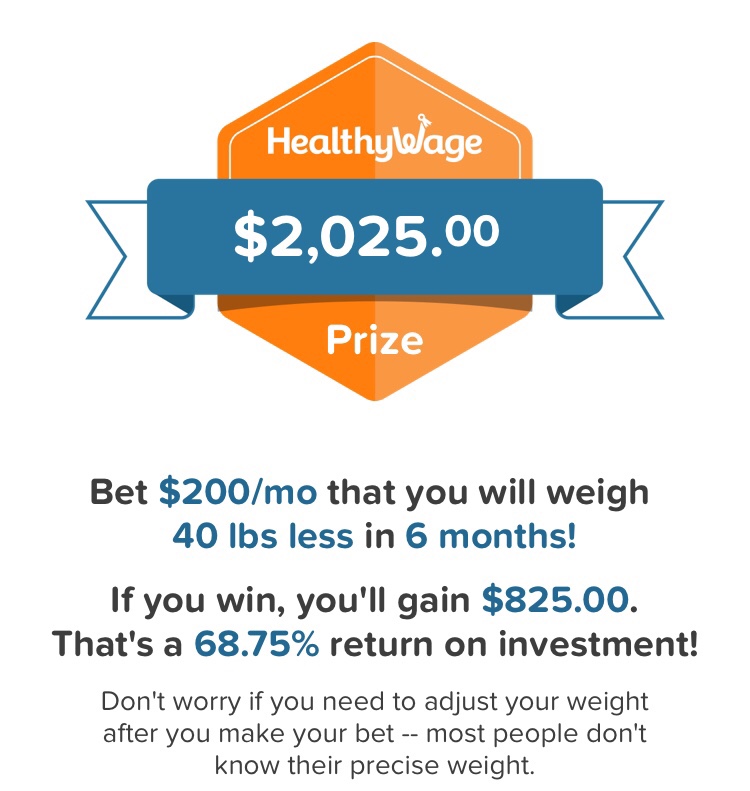
The BMIDL value of $825 is trumping the PPL value of $1,200. This is a sucker bet and should not be made.
Step 3: Find the Bet Amount for Maximum Net Gain
The woman should lower her bet to $825.16 (using the 99.98% ROI figure to divide into $825). Divide that by 6 and you get or $137.53 per month. This has to be rounded in one direction or the other to the nearest dollar.
Step 4: Query the Calculator at the Maximum Net Gain Bet Amount
Here’s the calculations at $137/month and $138/month:
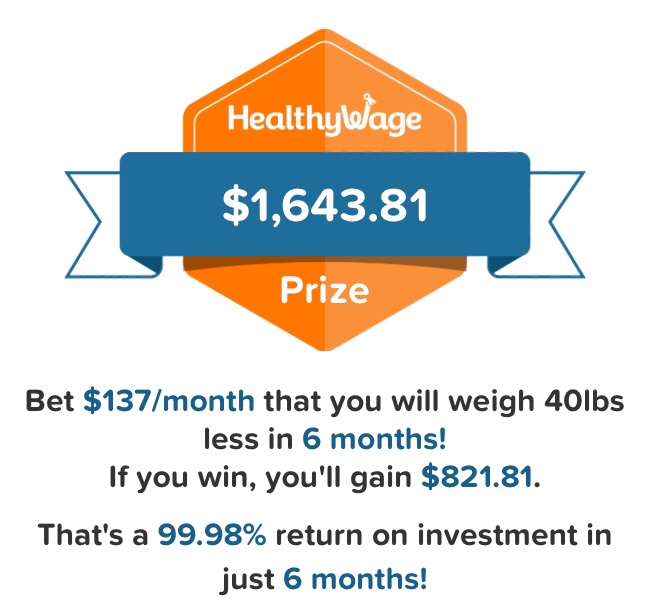
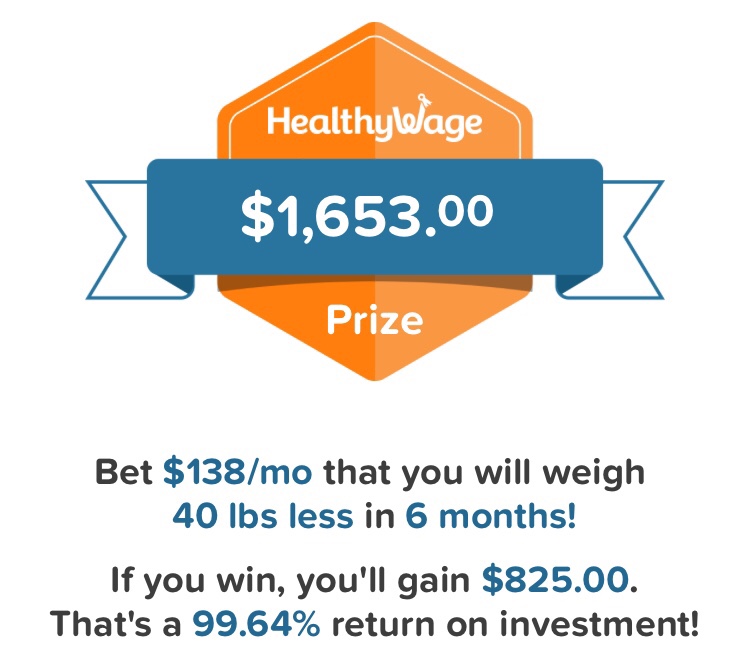
You can see the $825 plateau kicking in when you go up from $137/month to $138/month. The extra $6 in the $138/month bet earns $3.19, or 53.17%. The choice of one bet or the other bet is a matter or preference.
Before I get to step 5: a quick aside: If a 5’-8” man of 195 pounds made a 40 pound pledge, his maximum net gain would be $640, per the PPL formula. The BMIDL formula would fail to make a difference until the pledge was raised to 52 pounds, for which the PPL formula yields $832 and is finally greater than the $825 from the BMIDL formula.
Step 5: Iterate to Obtain a Better Bet
Reducing the pounds pledged in the woman’s wager will decrease the ROI. So the woman has to add money to the wager to get the same net gain. But the $825 plateau will remain until the pledge drops to 27 pounds, at which the PPL formula yields only $810.
Adding pounds to this woman’s wager is going to increase the ROI, but it won’t change the $825 limit imposed by the starting BMI. So the woman could bet less money to get the same $825, but cannot earn more than $825 even though the PPL formula yields a higher net gain plateau. I want to go into more detail on this now.
For instance, consider a 57-pound pledge over 9 months, which would get the woman to 138 pounds and about a 21 BMI:
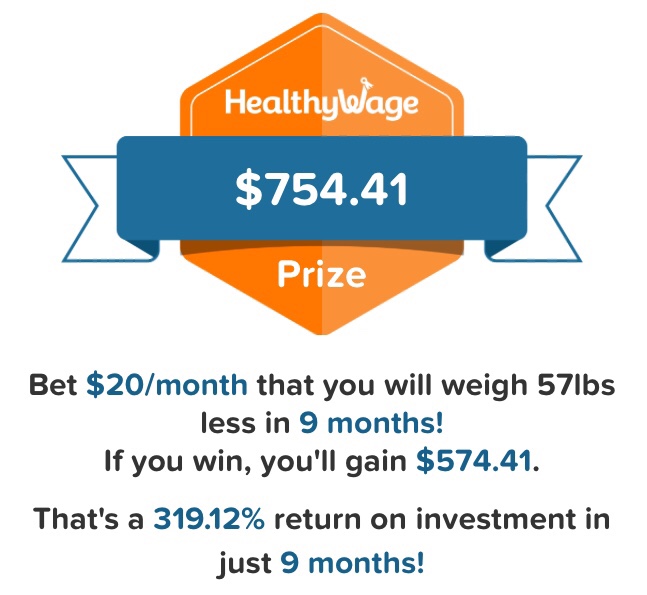
A triple-bonus formula bet. The $180 wager is multiplied by 194.12% to get $349.41. The flat bonus is $6.00 times the pledged weight exceeding 10% of starting weight:
$6.00 * (57 – 0.1*195) = $225
Both of those add up to the $574.41 net gain.
If the BMIDL formula didn’t exist, this woman would have a net gain plateau of $30 times 57 pounds by the PPL formula, which is $1,710. The corresponding wager in the triple bonus formula is $1,710 divided by 1.9412, or $880.90.
Divide that across 9 months and you have an ideal monthly payment of $97.88. As this is very close to $98, it makes sense to round up to $98 for the calculation—we gain more in the additional 88 cents per month from $97 than we lose in the further 12 cents per month.
Here’s the calculation for $98/month, 9 months, 57 pounds:

Sucker bet bigly.
Honoring the $825 net gain plateau from the BMIDL formula, the resulting net amount is $825/1.9412 or $424.99. Dividing 9 months into this yields $47.22 for an ideal monthly payment.
Let’s do the calculations at $47/month and $48/month:

The $423 is multiplied by 1.9412 to get $821.12 as the wager-dependent component of net gain. The $225 bonus from the minimum-stake bet is present here as well, and is added to the $821.12 to get $1,046.12 total net gain.

We went over the summit at $47.23 per month, and the benefit of the first 22 cents per month is more than offset by the cost of the further 78 cents per month. Not only is the latter 78 cents not earning any money, we have forfeited a bit of the $225 bonus along the way.
The $47/month bet is the better of the two. But both are infinitely better than wagering $98/month.
If the woman really does want to try for this—and if she starts now, she’ll have one hell of a beach body when next summer arrives—she should bet $47/month for the maximum net gain on the HealthyWager, and put any further money into concurrent 12-week mini challenges to keep her in track, and make even more money. The $10,000 team challenge is also available, of course.
 Weight Betting Odds