
 Posted by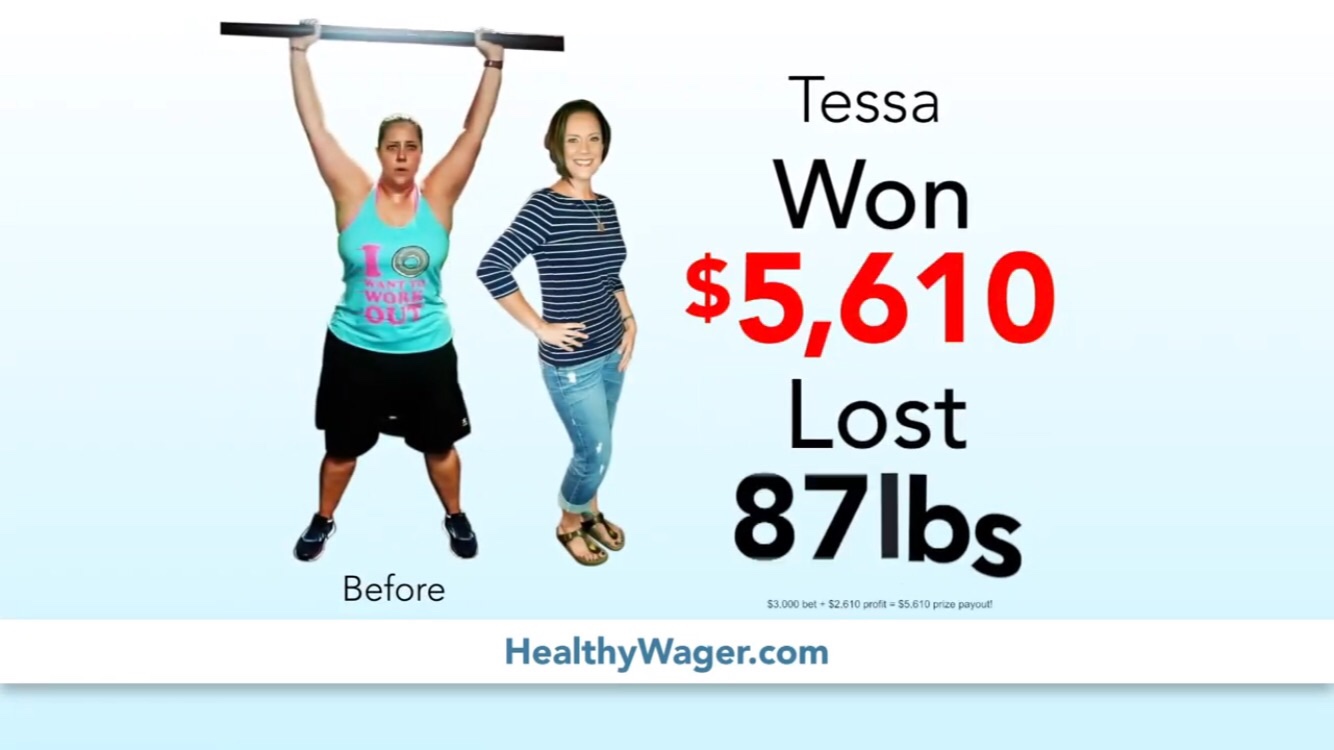
Note: $45 boost for all HealthyWagers available from now until September 30, 2019: click here
A link to her story in the Winning Skinny, here.
The weight loss speaks for itself. The pictures are gold.
But the payout is a problem. She bet $3,000–$250 per month for 12 months—and got her bet back plus $2,610 in gain. That’s a return on investment of 87%.
It is an example of the biggest calculator mistake you can make: betting more money than Healthy Wage will allow to be subjected to the odds multiplier, and having much of it getting pushed back to you without earning anything.
In other words, she slammed into her net gain ceiling—and hard.
I don’t even have to guess her weight and height and build a biometric profile for her to prove this. All I have to do is look at the minimum and maximum ranges for prizes for losing 87 pounds in 12 months, as I sweep the monthly payment from $9/month upward.
And I am going to do that here.
The Healthy Wage Range Finder

To follow along, go into the HealthyWage app, and log off if you are already logged on.
Then navigate to the first panel of the calculator—the one with the scroll bars. This is before you enter your gender, weight, and height. You can enter pounds pledged, time, and dollars per month—and you will get a range of prize values. The exact one depends on the gender, weight, and height; but you can actually learn some things about the calculator without entering that data (and without entering an email and password).
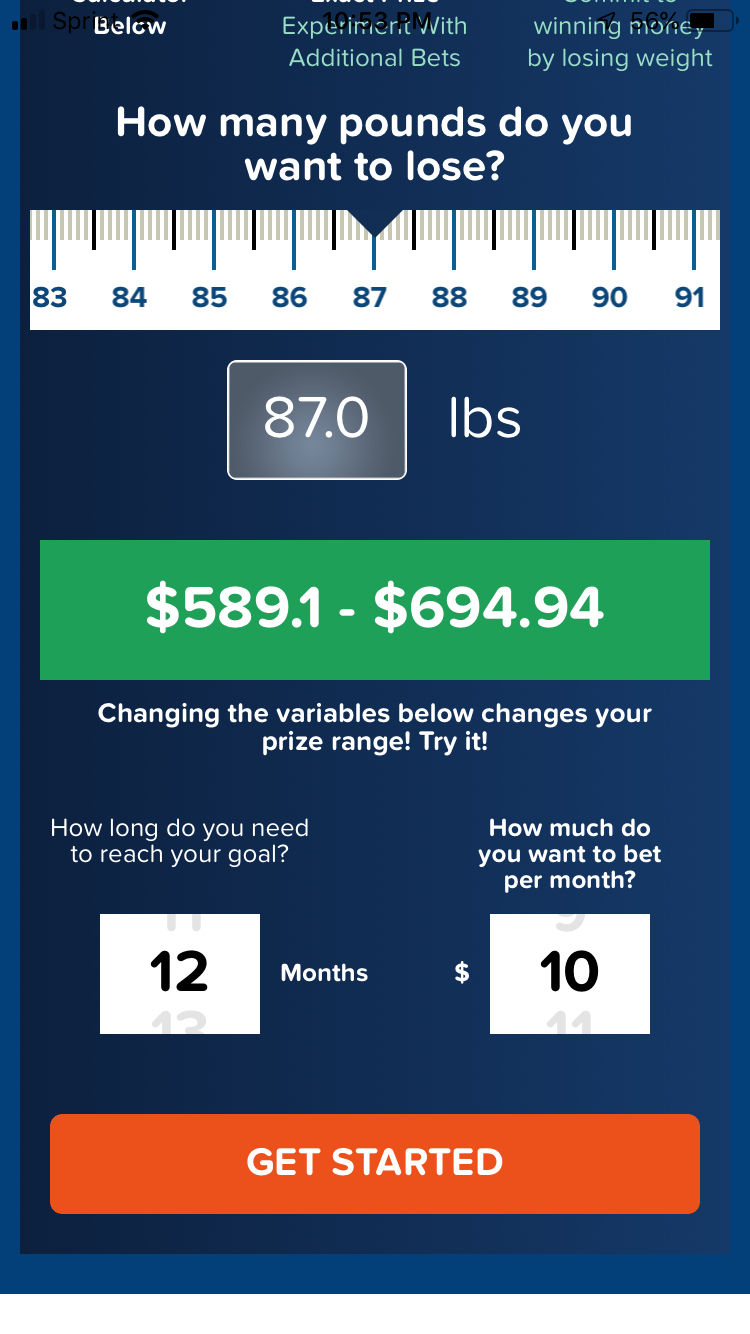
We are going to sweep from $9/month ($108 total bet in 12 months, the minimum possible) up to $300/month ($3,600 total bet). We will note how the min/max values in the green box change as we sweep.
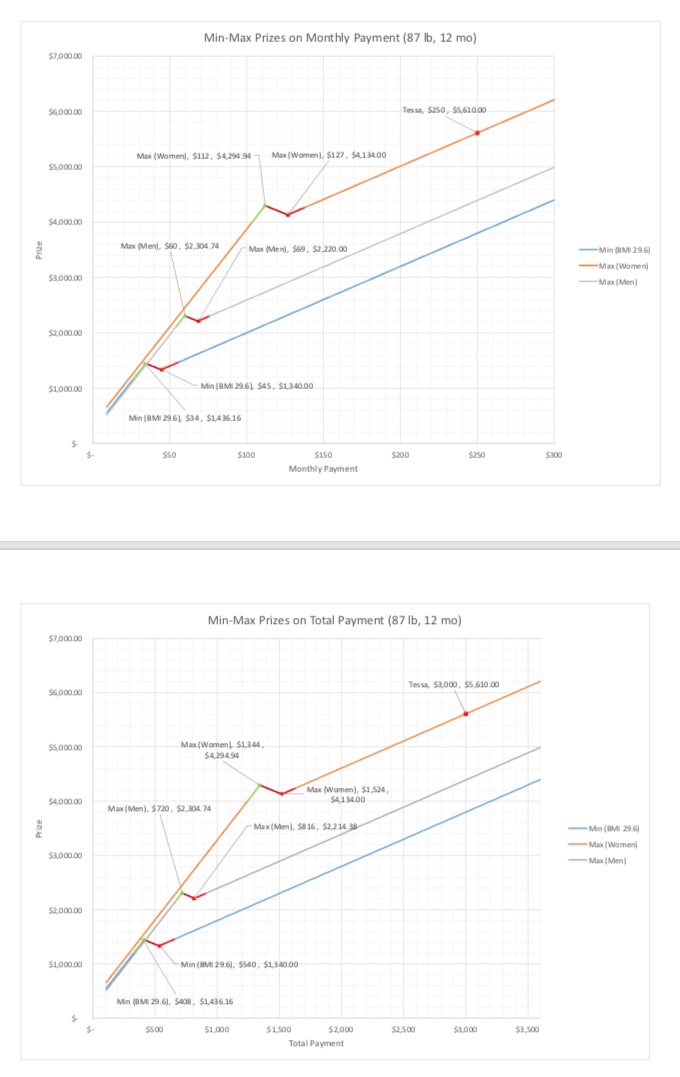
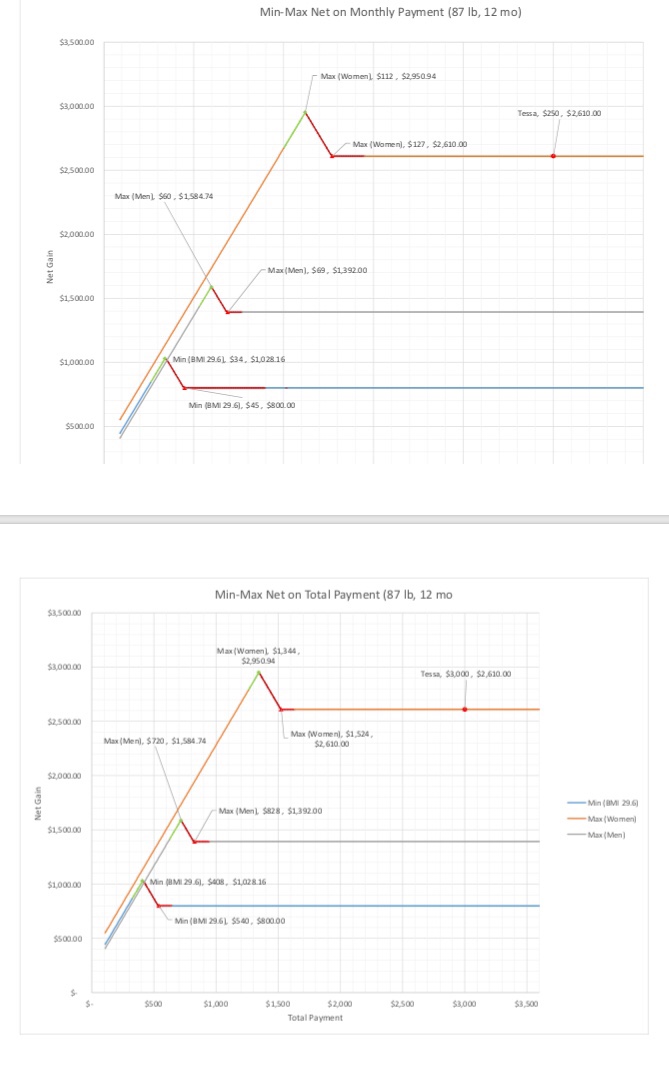
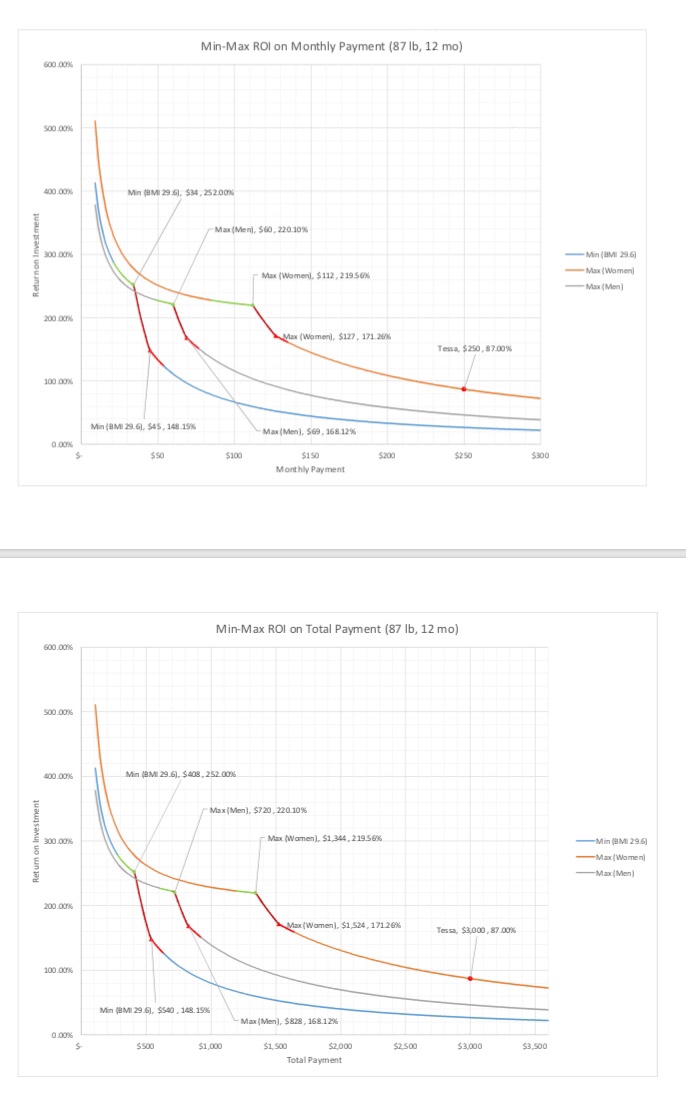
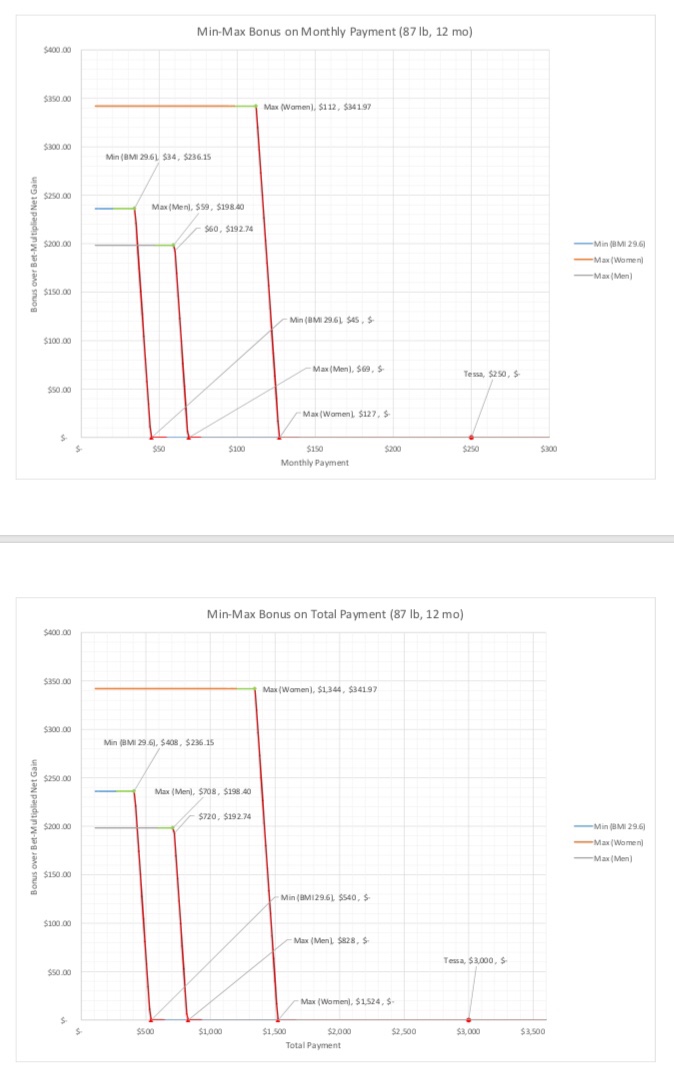
So we notice the following regions:
$9/month to $34/month: Triple-bonuses for all
Man or woman, all heights, all starting weights: for a completed 12-month, 87-pound pledge, Healthy Wage will pay back your bet plus 194.12% net gain (or, said another way, they pay back 294.12% of your bet—nearly tripling it).
In addition, they add a flat bonus on top, which is dependent on the pound count in the pledge, but independent of the bet size.
In the prize graphs, you see the the minimum and maximum prize bounds track each other closely. At $9 per pound, the range is $553.81 to $659.65. At $34 per pound, the range is $1,436.16 to $1,542.00. The difference between minimum and maximum is in the bonus size for men and women, and that is better seen in the bonus plots.
In the net gain graphs, you see a 194.12% slope (when plotted against total bet). But the bonus shifts the slope upward—so it doesn’t pass through the plot origin, but intercepts the vertical axis (zero bet) above the origin.
In the ROI graphs, you see huge ROIs at minimum stake, decreasing rapidly as the bet increases—but remaining well over 200% as the bet approaches $34/month or $408. This is the effect of the bet-multiplied portion of net gain becoming a larger portion of the total net gain (relative to the bonus) as the bet increases.
The bonus graphs are flat lined up to $34/month. Women get $6.00 per pledged pound in excess of 10% of their starting weight, while men only get $3.20 times that figure.
$35/month and above: The $800 minimum net gain plateau suppresses the minimum prize range (BMI driven)
One of the calculator features I pinned down last weekend was the net gain limiter that seems to target overweight or mildly obese women (high-20s to low-30s BMI) who are bidding to drop into the low 20s.
All other women can earn $30 per pound of pledged weight, plus the bonus if the pledge is large enough. But women trying to make it big in fashion or entertainment—or who just want a really slender body—have to take care that the BMI-Dependent Limit formula doesn’t impose a lower cap on net gain.
The BMIDL limits pre-bonus net gain to $800 for anyone who have a body mass index of 29.6 or less. For women with slightly higher BMIs, this figure goes up by $500 for every BMI point above 29.6. It is rounded to the nearest $5.
For instance, a BMI of 30.56 results in a pre-bonus net gain cap of $1,290. Any woman with this BMI who pledging to lose more than 44 pounds will find that the $1,290 cap will supersede the $30 per pound cap that is otherwise in effect for women (as $30 times $43 is $1,290). If a woman pledges 50 pounds of weight loss, she cannot expect to get $1,500 plus bonus on the calculator. Instead she can get $1,290 plus bonus.
Conversely, a man with the same 30.56 BMI can normally make only $16 per pledged pound, plus bonus. Thus the $1,290 cap will not make a difference for any weight pledge under 81 pounds. An 80-pound pledge has a $1,280 cap for men, which is less than $1,290. At 81 pounds the $1,290 from low BMI supersedes the $1,296 from the $16/pound formula.
But losing 81 pounds is unrealistic for just about anyone with BMIs in the range where the BMIDL formula would actually make a difference. The same goes for the 87 pound bet we are considering here.
So for the first screen in the Healthy Wage calculator, this $800 net gain plateau in the range display isn’t realistic. If you are seriously trying to lose 87 pounds, there is no way you have to worry about your prize being that low.
If you are a woman, generally the maximum limit in the range display is going to apply to you. Your BMI would have to be less than 33.22 for the BMI net gain limiter to affect you—as will be described later, your pledge-dependent net gain cap at 87 pounds is $2,610, which is equivalent to the BMI-dependent cap at 33.22 BMI.
If your BMI is greater than 33.22–as Tessa’s appears to be from her photos—that maximum limit is just about what you’re going to be offered when you set an 87-pound bet up. Your bonus may vary slightly depending on your starting weight, but only by a few dollars.
If you are a man, the values in the range display will be meaningless above $34 per month. The $800 cap that dominates the minimum value does not apply to you if you are in a realistic position to lose 87 pounds. And the maximum value represents the $30 per month cap for women generally, not the $16 per month cap for men.
Having said all this, let me briefly describe the $800 cap to you, because you see it here in the range display. At $35 per month and above, the additional dollars above the $34/month or $408 are not multiplied before returning to the bettor. They are just kicked back to the bettor. What’s more, the net gain bonus above $800 is gradually withdrawn as bet size increases.
Once bet size reaches $45/month or $540, the bonus is totally gone and all that is left net gain is the $800. The net gain remains flat at $800 for larger bets.
Again, it’s all theoretical. Nobody voluntarily losing 87 pounds is going to have a BMI of 29.6 or less.
Now that I have dispensed with this, read on as I describe the $16 per month net gain (plus bonus) for men that the range field conceals.
$9 to $60 per month: Triple-bonus betting range for men
The maximum net gain for men at 87 pounds of weight loss over 12 months is $16 times 87, or $1,392, plus the bonus for making such a grand pledge.
The bonus for men is $3.20 times the portion of the pledged weight amount that exceeds 10% of starting weight. If a man starts at 250 and tries to get to 163, the bonus will be $3.20 * (87 – 0.1*250) or $198.40. The more the man starts out at, the less the bonus will be. But at higher starting weights you can pledge more weight loss anyway to get the bonus up—and also the bet-multiplied portion of net gain, as your net gain cap goes up with pledged weight.
In the plots I assumed a 250-pound man for convenience. The plot and it’s constituent values are hidden in the range display—but because you are reading my blog you will know what they are.
For men, the maximum net gain and prize are available at $60 per month or $720 total bet. This gets a man a $1,584.74 gain and a $2,304.74 prize, with an ROI of 220.10%. You actually lose a little bit of bonus compared to $59 per month, but you more than make up for it in bet-multiplied gain (ideally, you’d bet $59.76 per month to get right on the net gain peak, but Healthy Wage requires round dollar bet amounts per month.
Beyond $60 per month, additional dollars are no longer multiplied for men, and the net gain bonus above $1,392 is gradually forfeited. At $69 per month the bonus is totally gone and the net gain remains at $1,392 for larger bets.
Of course, all of these bets over $60/month are sucker bets for men. Don’t make them.
$9 to $112 per month: Triple-bonus payouts for women
Women with BMI 33.22 or greater i.e. most of them) get $30 per pound plus bonus for their maximum net gain.
At $112/month, or $1,334 total, a woman can get $2,950.94 net gain and $4,294.94 prize, with an ROI of 219.56%. The net gain is $2,619 pulse the bonus, which is assumed by the range display to be $341.97 (corresponding to a starting weight of 300 pounds).
The bonus is depleted as the bet increases from $113 to $127 per month.
From $127 on, the bonus is zero, and the $2,610 remains for all larger bets…including the $250 per month that Tessa put down.
Coda
I am so glad that Tessa made it. She was pre-diabetic. Now she no longer is. And she got to go to the eastern seaboard to film that ad with some other winners.
And she got a lot of money—$2,610–for her efforts. Healthy Wage made nothing.
But what if she had gotten to the end of her 12 months and was close to goal, but not quite there? She would have the nasty dilemma of forfeiting $3,000 or paying another $1,500 over 6 months to extend her wager for that same period of time. She’d net only $1,160 on the entire endeavor when she finally got to goal.
Had she known what I just described about the calculator and its net gain limits, and bet $112 per month or $1,334 in the HealthyWager, her net gain would be around $2,950 if she made it in 12 months. If she had to extend, she could still pick up that money—but the extension would cost her only $672, not $1,500. Her profit after one extension would be about $2,278, not $1,160.
The $250 per month is definitely a motivating factor. Perhaps it performs that function better for some people than $112 would (but not me!). But if you feel you need to put that extra $138 per month to work, you can do so by investing in 12-week challenges, or 8-week step challenges… or $10,000 jackpots (affiliate link to earn me commissions; thanks in advance!). These are not subject to net gain restrictions.
I don’t mean to be a Debbie Downer, but net gain caps are net gain caps.
 Weight Betting Odds