
 Posted by
 Women have a harder time losing weight than men, and here is the apples-to-apples proof.
A correspondent asked me to provide payout figures for losing 43 or 53 pounds. The person is 243 pounds now, and 6’1” tall.
What he or she left out was gender. I don’t know if this person is a man or a woman. I asked for that piece of information and haven’t heard back yet.
But I went ahead and modeled both cases, because I wanted to see what difference sex makes when all the other biometric data is the same.
The moral of this story is: at Healthy Wage, it’s good to be a woman if you are good at losing weight. They will pay you more than they pay a man. It’s the inverse of the wage gap we hear all about it the news and in politics. And however you view the wage data in that national debate, once you stick the word “Healthy” in front of “Wage”, it is undeniable that women earn more with everything else held equal.
Let’s dive into the weeds, shall we?
Male or female, a 243 pound person who is 73 inches tall has a BMI of 32. This is within the Category I classification of obesity that covers BMIs from 30-35. Of course, any person who is 6’1” is much more likely to be a man than a woman—in the U.S., this is a 93rd percentile height for a man, and a 99th percentile height for a woman. But it was easy to run both cases so I didn’t need to make assumptions here.
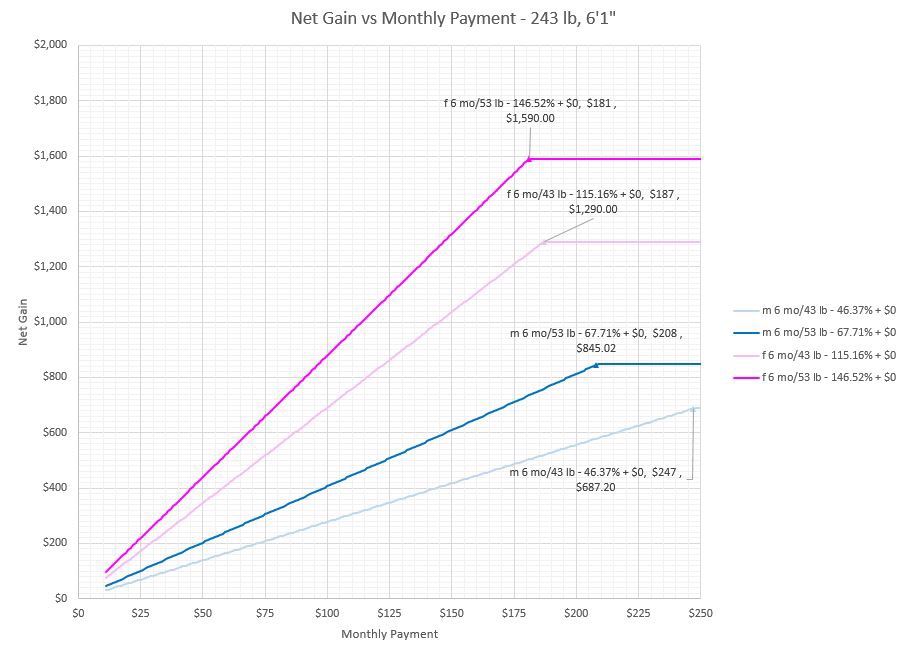
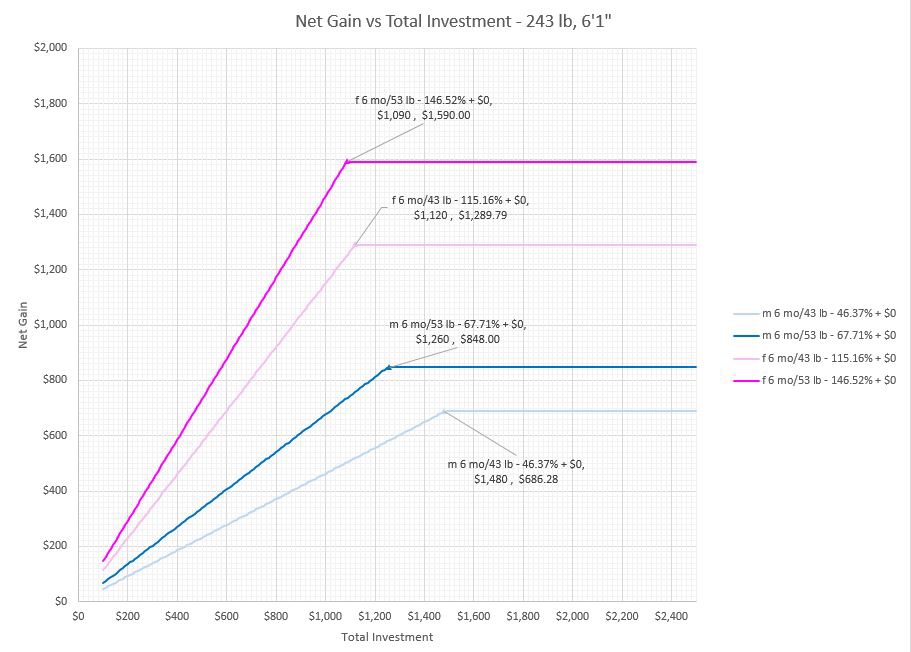
Here are the 6-month cases for a man and a woman plotted together:
- Light blue: man losing 43 pounds, to get to 200
- Dark blue: man losing 53 pounds, to get to 190
- Light pink: woman losing 43 pounds, to get to 200
- Dark pink: woman losing 53 pounds, to get to 190
All of these bets are in the regular payout formula—the players aren’t going to triple their money without getting substantial referral boosts. But as you will see, the woman gets better ROI than the man; and she also has more net gain opportunity .
The 6’1” man—again, male is the most likely case for that height—is offered 46.37% return on investment for the 43 lb pledge in 6 months. He enjoys that percentage for all bets from the $17/month or $102 minimum ($47.30 gain, $149.30 prize) up to $247/mo or $1,482.
At $247/mo he gets that $1,482 back plus $687.20 in gain, for a prize of $2,169.20. At $248/mo or $1,488 invested, he gets the $1,488 back plus $688.00 in gain, for a prize of $2,176.00–that extra $6 earned only 80 cents in gain. At $249/mo or greater, the net gain is capped at $688–those are technically sucker bets as the additional dollars do not earn any more additional money.
The $688 is $16 for each pound pledged by the man to lose. As you will see below, women are offered much more per pound than men.
Adding 10 pounds to the pledge both increases ROI and the net gain opportunity. At 53 pounds, the ROI is 67.71% and the net gain opportunity is $16 times 53 or $848.
A $17/mo, $102 minimum bet yields $69.06 gain and $171.06 prize. At $208/mo or $1,248, gain is $845.02 and prize is $2,093.02. At $209/mo or $1,254, gain hits the $848 cap and the prize is $2,102–the extra $6 earns about $3 in extra gain. $210/mo or higher is true sucker bet territory.
Now… if you change the gender from a man to a woman, you get the following enhancements:
- For the 43 pound bet, the ROI is 115.16% and the maximum net gain opportunity is $30/pound or $1,290.
- Minimum bet of $17/mo $102 yields $117.46 gain and $219.46 prize
- The maximum bet that retains the full ROI is $186/mo or $1,116. This yields $1,285.19 gain and $2,401.19 prize.
- At $187/mo or $1,122, you hit the $1,290 net gain maximum, and the prize is $2,412.
- For a 53 pound pledge, ROI is 146.52% and net gain maximum is $30 per pound or $1,590.
- Minimum bet of $17/mo $102 yields $149.45 gain and $251.45 prize
- The maximum bet that retains the full ROI is $180/mo or $1,080. This yields $1,582.42 gain and $2,662.42 prize.
- At $181/mo or $1,086, you hit the $1,590 net gain maximum, and the prize is $2,676.
In all cases, bumping the time frame up to 7 months improves the ROIs slightly—1% to 3%. So you can spread slightly less money over more months to get the same gain as before and reduce the weekly rate of weight loss you need to make your bet.
Losing 53 pounds to get to 190 means that the BMI for these people will be 25. Thats right at the lower borderline of the “overweight” classification that covers BMIs between 25 and 30.
Both people may wish to lose more weight to get a BMI in the low 20s. They will likely take more time to do so. I will provide some opportunity payouts here for the man and the woman here.
For the man:
- Pledging 60 pounds in 9 months yields an ROI of 92.89% and a net gain opportunity of $960, achievable at approximately $115/month
- Pledging 70 pounds in 12 months yields an ROI of 141.33% and a net gain opportunity of $1,120, achievable at approximately $66/month
- Pledging 77 pounds in 13 months yields an ROI of 187.52% and a net gain opportunity of $1,232, achievable at $51/month
- Pledging 78 pounds in 13 months puts the man into the triple-bonus formula. His gain is 194.12% of his investment plus a flat bonus of $171.84–this is $3.20 for every pound pledged in excess of 10% of starting weight. If he bets $49/month or $637, he can get a $1,408.38 gain and a $2,045.38 prize.
Getting the man into the triple-bonus formula in 13 months requires a 165 pound goal weight. The corresponding BMI is 21.8. This is quite lean for a man.
For the woman, different considerations are in effect—including the BMI-dependent limit on net gain opportunity:
- Pledging 60 pounds in 9 months yields an ROI of 183.54% and a net gain opportunity of $1,800, achievable at approximately $109/month
- Pledging 62 pounds in 10 months triggers the triple-bonus formula. Her net gain is 194.12% of her investment plus a flat bonus of $226.20. The bonus is $6.00 for every pound pledged in excess of 10% of starting weight. If she bets $96/month or $950, she can get a maximum $2,082.65 gain and a $3,042.65 prize. Her final weight will be 181 and her final BMI will be 23.9.
- Pledging 68 pounds or more in any amount of time is going to result in triple-bonus formula payout. However, the BMI-dependent net gain limit—$2,030 plus bonus—will be felt at the 68 pound level and above, superseding the $30-per-pound-plus-bonus that is normally in effect. I discuss BMI-dependent net gain limits in more detail elsewhere, but the upshot in this case is that the maximum net gain opportunity is available when the woman bets $1,045 spread across the number of months involved. But 68 pounds means final weight will be 175, and final BMI 23.08. It’s a remote possibility that such a bet will ever be made at Healthy Wage.
Conclusion for my correspondent
Since my corespondent is 6’1”, I expect he or she will identify as a man, and so the paltry ROIs are going to be the ones that govern here.
I suggested that if this is the case, he should make a minimum bet and use a referral code to get the prize up. With a $40 boost, a $102 bet to lose 43 pounds in 6 months will then earn $87.30 in new money, not $47.30. That’s an 85.5% ROI for that bet.
The rest of his stake should go into the following investments:
- 6% 12-week jackpot challenges, also offered by Healthy Wage. He’s already commuting to losing 17.7% of his weight in 6 months, so he should enroll in as many as he can afford and reinvest the winnings when they come back. If he enrolled in 2 a week for the first 14 weeks, he will spend the latter half of the 6 months weighing out and gathering the winnings from those bets. It may be over $700 in additional gain.
- 6-month, 10% transformers, offered by DietBet. For these he would have to weigh in every month to collect on the intermediate pots. But at the end, he could turn $175 into $325 or more for one transformer. If he did the maximum of 3, he could make $450 or more in profit.
For shorter humans
I think it is fascinating to see Healthy Wage offer more money to women than men. They really do think that women have a tougher time losing weight than men do. So many women who make that claim can now feel vindicated.
I would like to show you the graphs for two 243 pound people—one man, one woman—losing 43 and 53 pounds. The difference this time from the above case is that the people are only 5’8” tall.
So the man is in the 35th percentile for height—slightly shorter than average—and the woman is in the 96th percentile—still taller than most women, but not quite the outlier that the 6’1” woman is. Both people have a BMI of 36.9–slightly into the Category II obesity classification that covers BMIs from 35-40.
Here is a plot of net gain versus total investment for the man and woman losing various amounts of weight. You can see the man’s bets (green and blue colors) yield less net gain than those of the woman (yellow and orange colors). In some cases, the differences are dramatic.

So the man gets 105.62% return for a 43 pound pledge—slightly better than double (light blue). This rises to 135.59% for a 53 pound pledge—slightly better than 4:3 odds (dark blue).
It takes about 65 to 67 pounds of weight loss to get into the triple-bonus formula, depending on how many months are involved in the bet. That’s a final weight of 178 or less. For a 6’1” man that is quite lean, although doable.
In the plot I show a 66 pound pledge for 6 months (light green), and 67 pounds for 10 months (dark green), so you can see the difference that one pound makes.
A 67 pound pledge for this man has a maximum net gain opportunity consisting of the sum of 2 terms:
- $16 times number of pounds pledged: $16 * 67 = $1,07
- Flat bonus of $3.20 times number of pounds pledged in excess of 10% of starting weight: $3.20 * (67 – 0.1*243) = $3.20*42.7 = $136.64
If the 243-pound, 5’8” man pledges 67 pounds of weight loss for 10 months, and wants to maximize net gain, he would bet $55 per month. This is the $1,072 figure above divided by 194.12%, divided across 10 months and rounded down.
If he won the bet he would get his $550 back, plus a gain consisting of 194.12% times $550 ($1,067.66), plus the flat bonus of $136.64. His prize would be $1,754.33, including $1,204.33 in new money from Healthy Wage.
The 5’8” woman has it easier. To get the triple-bonus formula, she can do a 6 month bet for as little as 42 pounds. For maximum net gain she can get the sum of $30 times 42 pounds or $1,260, plus bonus of $6 times (42 – 0.1*243) or $106.20, for a total of $1,366.20 ideally. Practically, she can get $1,364.10 net gain by betting $108/month or $648, and her prize would be $2,012.10.
The plot shows the 41 pound (yellow) vs 42 pound (light orange) cases for 6 months, so you can see the payout differences between them. 53 pounds (dark orange) is also shown.
A BMI of 24.8 is achievable with a pledge of 80 pounds. Let’s assume a 12 month pledge of 80 pounds. For maximum possible net gain, we have the bet-dependent component of $30 * 80 or $2,400; plus a bonus of $6 * (80 – 0.1*243) = $344.20, for a an ideal total of $2,744.20.
Practically, a bet of $103/mo or $1,236 will yield a $2,733.52 gain and a $3,969.52 prize. This is depicted in the dark red graph.
 Weight Betting Odds