
 Posted by
 This post deals with 6-month HealthyWagers and what the calculator is likely to offer you for completing that wager when the pledge is “moderate.”
I have been trying for a long time to figure out the formula for return on investment when that value is less than 194.12%.
For a long time I have known with pinpoint accuracy what the calculator will offer you when the pledge is aggressive enough to land you in the “triple-bonus” formula. In that case, they will pay you 194.12% on every dollar you bet, plus a bet-independent bonus that depends on the pounds pledged. That’s almost always a tripling or better of your money.
For the more moderate pledges, they pay you a variable ROI on your bet, without any such bonus. That value can be as low as 11.1% and as high as 194.12%.
What I have been trying to figure out is what they will offer you without going into the calculator to check. Because it’s a pain to go in there and you need to enter an email and password and lock in your weight and height data—you can change your weight on your account, but it requires intervention by customer service.
So at this point, although I do not have the ROI secret sauce, I do have some trends that I can graph.
Let’s start with the men. Here’s a graph of ROI for men of different body mass indexes (BMI) making 6-month HealthyWagers, with the weight pledge expressed as percentage of starting weight:
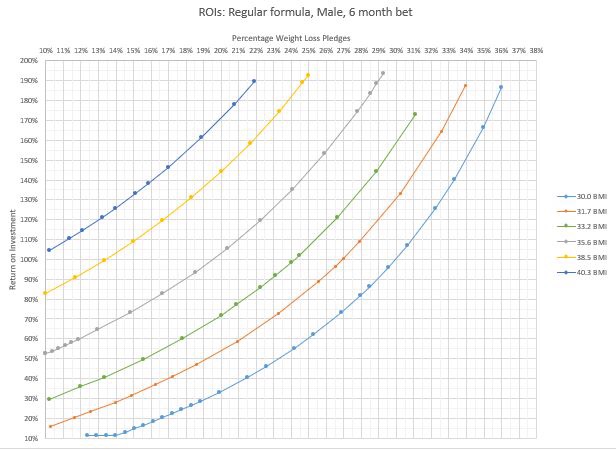
BMI is weight divided by height squared. Here are the weights and heights of the men modeled here:
- BMI 30.0: 186 lb, 5-6
- BMI 31.7: 215 lb, 5-9
- BMI 33.2: 225 lb, 5-9
- BMI 35.6, 270 lb, 6-1
- BMI 38.5, 300 lb, 6-2
- BMI 40.3: 265 lb, 5-8
As weight pledge is increased, the ROI increases, which makes sense.
They look like pretty curves. Note that for the lowest BMI on here (30.0), the smallest pledges hit the 11.1% ROI floor.
As BMI shifts upward, the ROI curves shift upward.
Note that these curves are independent of bet size. As long as net gain (in dollars) is kept at or below $16 times the number of pounds pledged, these curves will remain in effect.
The curves as plotted end at 194.12% at the points of highest percentage of weight pledged. If more weight is pledged to be lost, the payout formula shifts to the triple bonus model mentioned up-thread.
Any man trying to set up a bet who finds themselves on one of these plotted curves, and near the upper end of it, should explore if he can increase the pledge to get into the triple-bonus formula, as it pays much better than the regular formula.
Here are the same curves—but with ROI on a logarithmic scale:
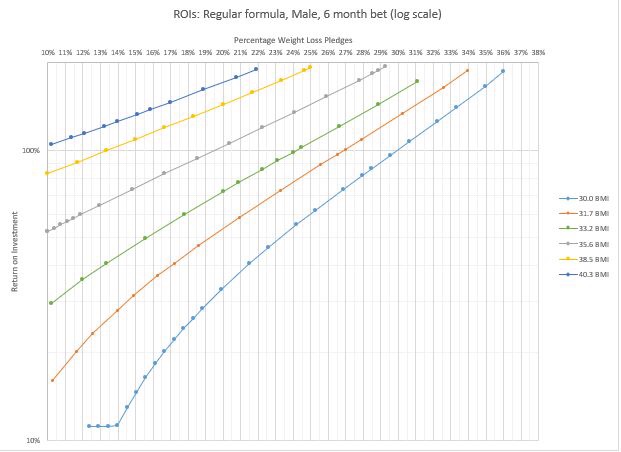
The curves become largely flat when ROI is on a log scale. With BMI under 35, there is some curvature at the lower weight pledge percentages. But for obese men, you have linearity when between pledge percentage and the logarithm or ROI.
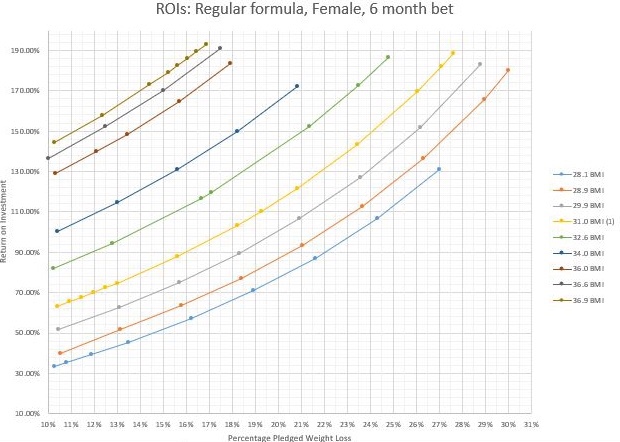
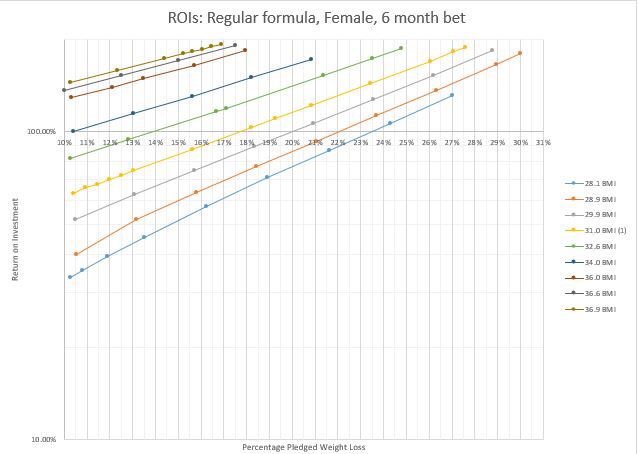
Here are the same graphs for females. Again, 6 month bets.
Linear ROI
Logarithmic ROI
The weights and heights:
- BMI 28.9: 190 lb, 5-8
- BMI 29.9: 191 lb, 5-7
- BMI 31.0: 192 lb , 5-6 (also 175 lb, 5-3)
- BMI 32.6: 234 lb, 5-11
- BMI 34.0: 192 lb, 5-3
- BMI 36.0: 223 lb, 5-6
- BMI 36.6: 200 lb, 5-2
- BMI 36.9: 243 lb, 5-8
- BMI 38.0: 250 lb. 5-8
Note that these female ROI curves are higher than the male ones. A 30.0 BMI man pledging to lose 20% of his weight in 6 months will be offered about 34% ROI, while a 29.9 BMI woman gets 80% for that same effort.
The man needs to increase his pledge to about 37% to get his ROI over 194.12% and enter the triple-bonus formula. The woman needs only a 29.9% pledge to get the triple-bonus formula.
I have said before that women get paid better than men for HealthyWagers, and this is one measure of that. (The other main measure is the higher upper limits on net gain that women enjoy for large wagers.)
Coming soon
I will graph moderate ROI for bets involving 7-18 months of weight loss. But I can say now that the addition of months to a wager, holding everything else the same, causes ROI to increase slightly.
So if a player is getting ROIs at 6 months in the 175-194% range, increasing the duration of the bet may cause a shift into the triple-bonus formula, and therefore more money paid out.
 Weight Betting Odds