
 Posted by
 OK, I think I got this working pretty well now.
I’ll tinker with it further, as I learn more about OpenAsApp and XML coding and so forth. But right now I can demonstrate to you how you can set up a simple HealthyWager where you know how much you would like to lose and in what period of time, and find out within a minute how much money you should be to get the maximum profit from the effort.
So let’s assume you’re a 305-pound man and you want to drop 50 pounds in 6 months. If you set up a HealthyWager, how much profit can you earn from this—from an absolute dollar perspective?
If you go into the Healthy Wage site, you’ll have to do some trial and error to figure out the maximum profit. You’ll enter the bet parameters for one bet, and then you’ll have to calculate more bets one by one—adjusting the monthly payment up and down until you zero in on the optimal monthly payment. Too little and you do not earn maximum profit; too much and you are putting excess money at risk.
If you use HWSim first, though, you’ll get that value almost immediately. You will then enter the Healthy Wage site and confirm it.I
I should point out here that HWSim is actually a close approximation of the official Healthy Wage calculator. It is very close, but when you set up your official HealthyWager you may be making some slight adjustments to what HWSim tells you. But in the end it won’t matter much.
Starting at the Launch page
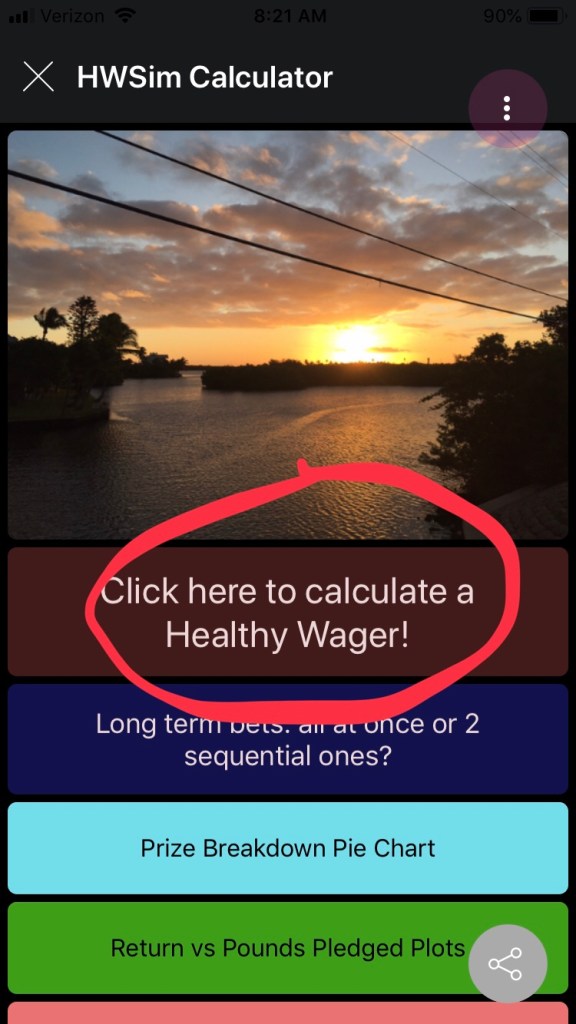
Let’s start with the launch page of the HWSim app. Click on the big brown button marked “Click here to calculate a HealthyWager” to start.
HealthyWager Calculation Page
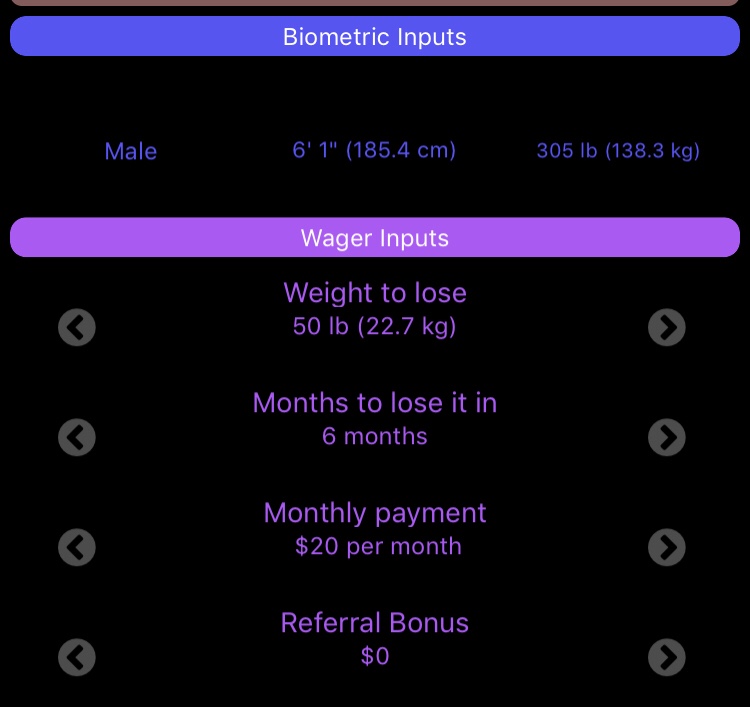
So you go to the HealthyWager Calculation page, where you enter your biometric data. Assume Male, 305 lb, and 6’-1” height:

For the wager definition, enter 50 lb in 6 months. Also enter $20/month for the monthly payment to get a baseline payout. We’ll assume $0 referral boost for now—although you can always get at least $40 if you use a referral link:

You’ll get the following payout information:
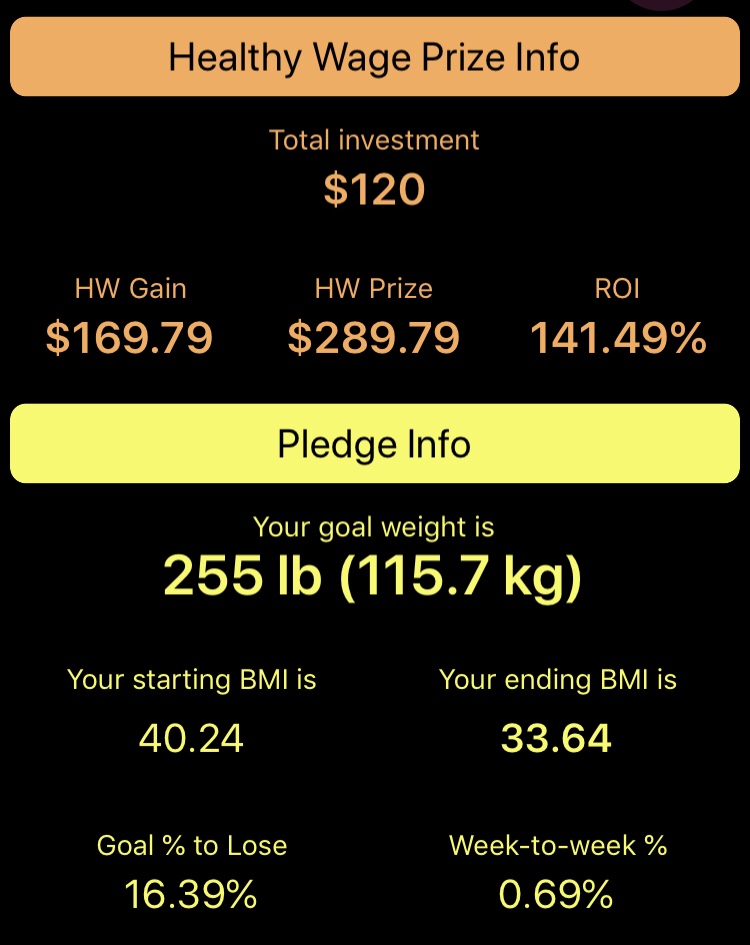
So they are paying out 141% profit on this bet—about 7:5 odds. As you will see later, this percentage will hold across all monthly payment levels—up to a certain point.
The ending weight is shown, as well as change in BMI, percentage of weight loss over the 6 months, and week-to-week rate of weight loss required to complete the bet.
This bet will take the man from BMI of 40.24 (beginning of morbid obesity) to 33.64 (in the middle of Class 1 obesity—still obese, but only moderately so).
The 0.69% week-to-week rate is not a leisurely pace, but is still moderate. Values like 1% are fairly brisk.
Healthy Wage considers anything exceeding 1.5% to be unhealthy—this is based on their 16.59% maximum limit for credited weight loss in a 12-week team challenge. (If you take the 12th root of 0.8341–that’s 83.41%, or the percentage of your starting weight remaining if you lose 16.59%—you get exactly 0.995, which is equivalent losing 0.5% of your weight in a single week.)
You also see information about wager quality, and the formula type that is in effect for this wager:
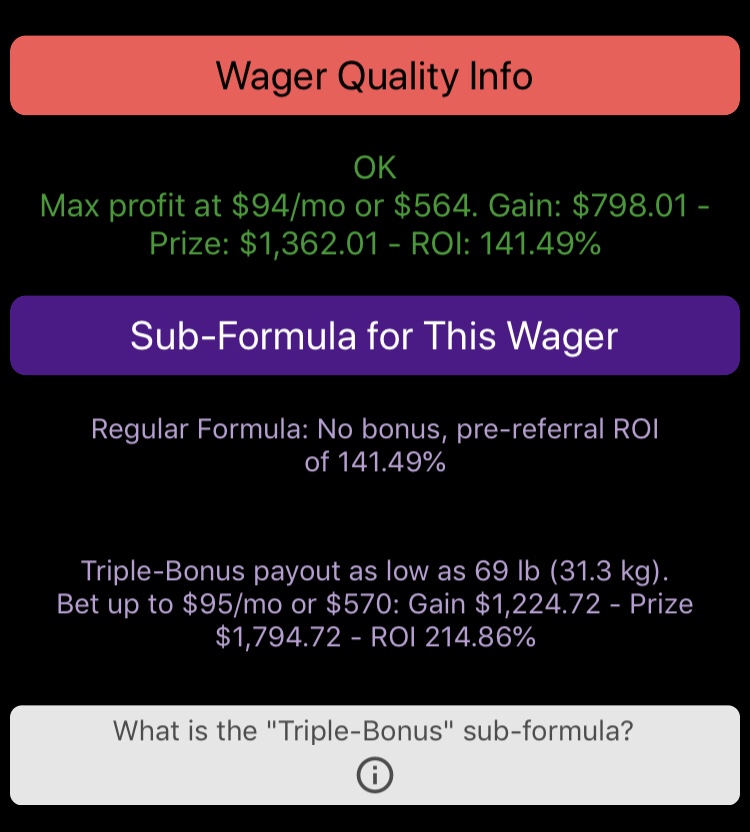
The Wager Quality will tell you if the bet is not legal or not recommended.
An illegal bet would be one in which you pledge to lose less than 10% of your weight, or risk less than $100. Healthy Wage will prohibit you from signing up for either one and will not quote you payout information.
Bets that are “not recommended” are something that only HWSim will tell you—Healthy Wage will let you sign up for them, but you really shouldn’t. There are two types of “not recommended” bets:
- Bets for too much money, that cause a hidden net gain cap to be breached, I.e. sucker bets. Healthy Wage will definitely permit them.
- Bets for too much overall weight loss (final BMI under 18, which I am defining as unsafe in HWSim—people can argue about that, but don’t be surprised if Healthy Wage referees give you any grief over it during the execution of the bet)
- Bets for too much weight loss in too little time—I am defining this as having a week-to-week weight loss rate exceeding 1.5%. As with the low-BMI situation, this is a judgment call for me. Healthy Wage refs may look sideways at these sort of bets as well.
In the man’s example bet, things are OK. Notice that the text recommends betting $94/month to maximize profit. More on that below!
In the “Sub-formula for This Wager” section, it says the payout is using the “regular” sub-formula, in which a constant ROI is calculated based on the bet parameters.
This is the less lucrative of the two sub-formulas. The more lucrative one is the “triple-bonus” formula, which requires more weight to be pledged (generally) to trigger.
There is a message about how much weight to pledge to just barely trigger the triple-bonus formula, and how much to bet per month to maximize the profit if you do chose to pledge that much weight loss. But for now, let’s stick with 50 pounds in 6 months and see how much weight can be made from that effort.
Here is what Healthy Wage calculates this bet to be:
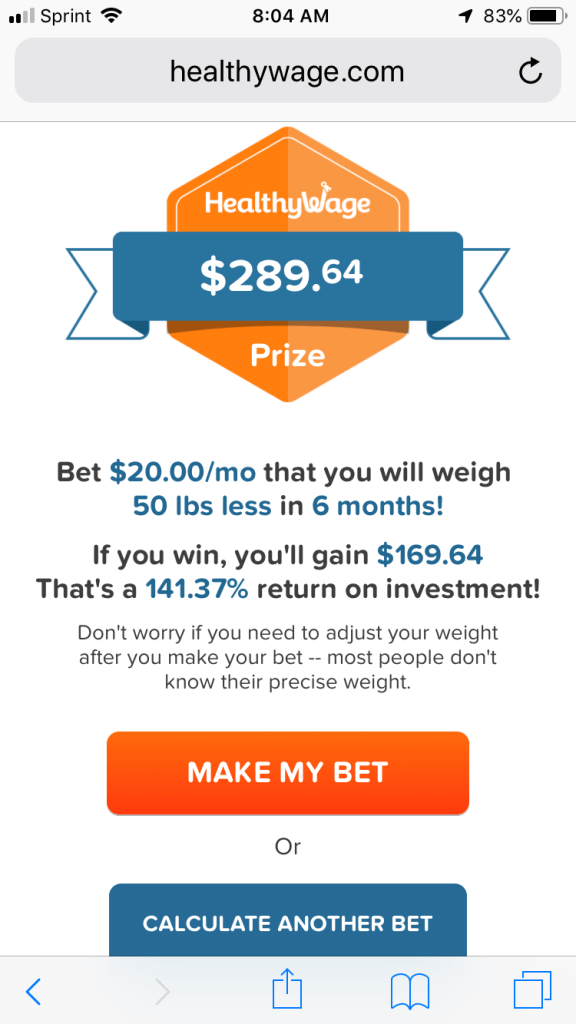
The error in HWSim is $0.15.
Sweeping wager amount and viewing profit levels—Return vs Wagered Dollars
The man then clicks on the Return vs Wagered Dollars button to switch to that page.

The biometric and wager inputs appear here again—the user can change them here if he wants to.
The graph controls and display:

This shows a wide range of monthly wagers and their corresponding payouts. These can be displayed in terms of gain (profit), prize (profit plus bet amount), and ROI.
This bet conforms to the regular payout sub-formula. With zero referral bonus, you’ll see the gain ramp up smoothly to a point, and then flatline. The flatline point is $800–this is $16 for each of the 50 pounds pledged, since this is a man doing the wagering. (Women get $30 per pound pledged in the regular sub-formula.)
The blue line represents the $20 per month bet. The green line represents $94 per month—at this point, net gain is very close to the $800 flatline. At $95 per month or greater, net gain no longer increases, so the extra money wagered does no work.
Here is the prize plot. You can see the slope change at the $94 per pound point. The flatline effect on gain is not so obvious in the prize plot.

The ROI plot is here. You see that ROI is flat to the left of $94 per month, then deteriorated to the right of it.
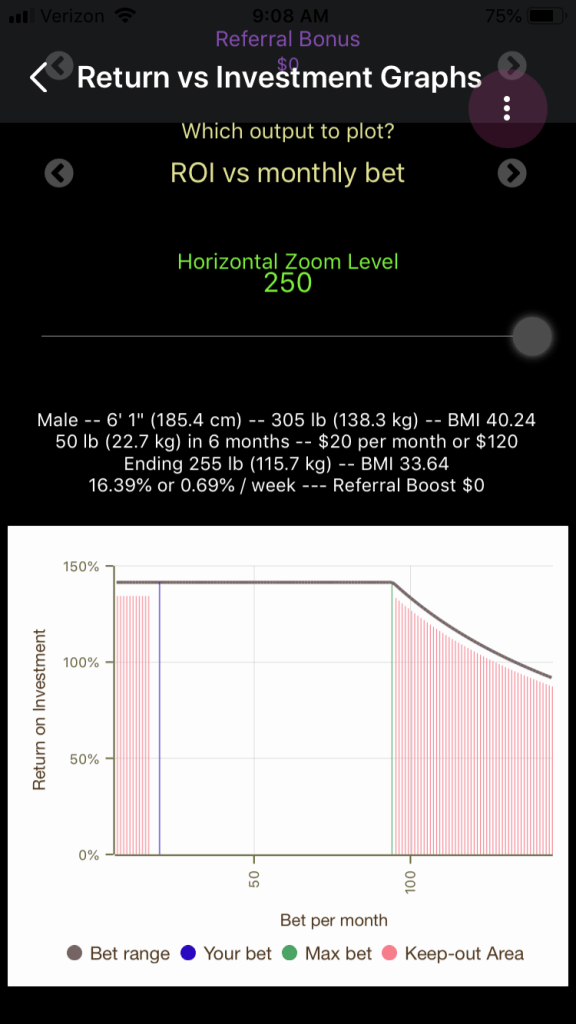
These plots can be rendered with total bet on the horizontal axis, instead of bet per month.
Below the graphs is the data table, which is searchable.
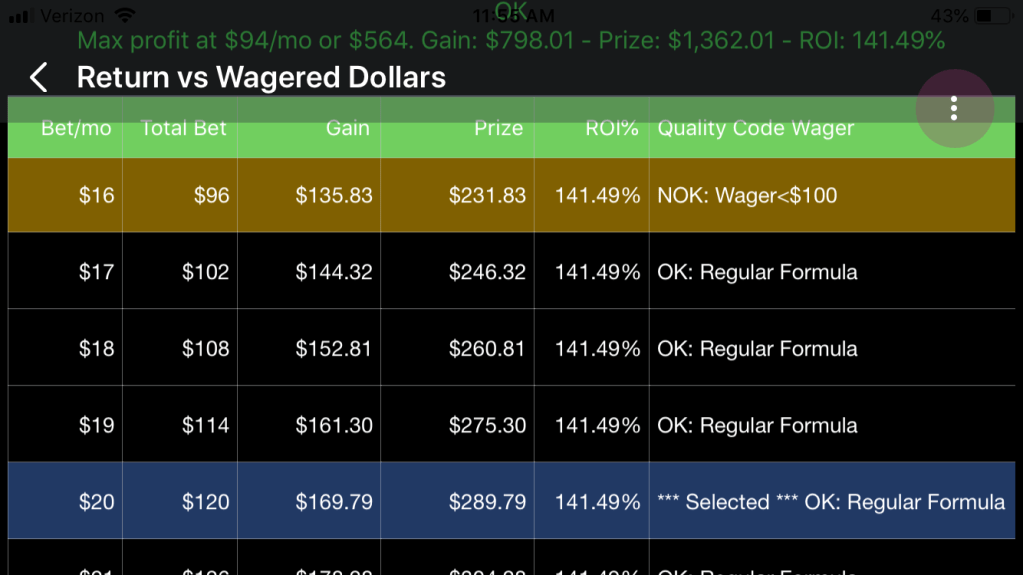
You can see the $20/month bet selected. The $16/month is flagged as NOK, since it’s less than $100 over the 6 months and is therefore unavailable for signing up.
Scrolling down to $94/month:
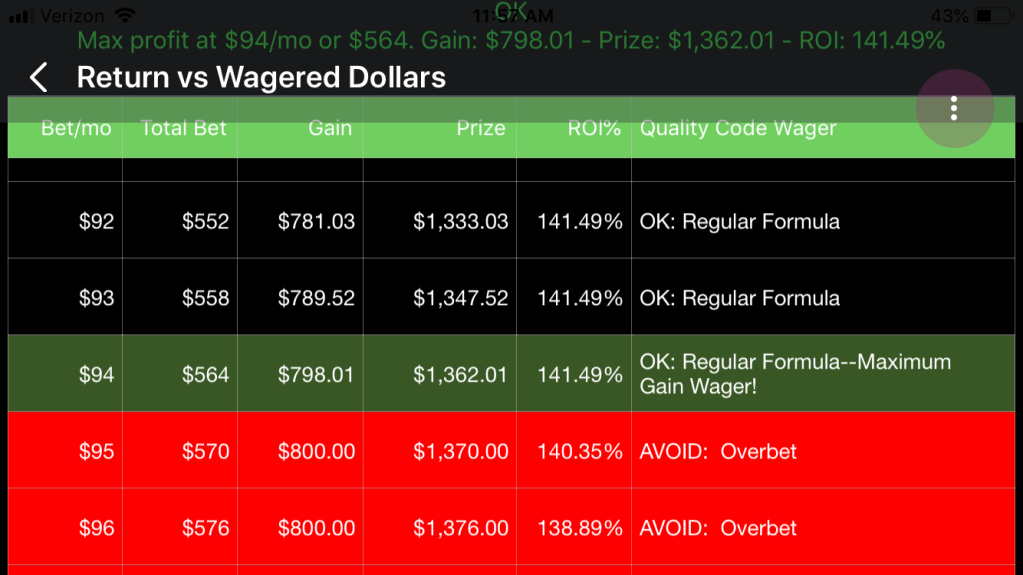
The gain at $94/month is just under $800. The ROI is the same 141.89% as it was at the $20/month level.
Starting at $95/month and going up, the gain is clamped at $800 and the ROI starts going down. These bets are “overbets” and should be avoided.
Next steps
The man—a High Roller—scrolls to the top of the screen and adjusts the bet amount to $94/month, and enters $40 for the referral amount. He gets the following updates to the graph and data list:
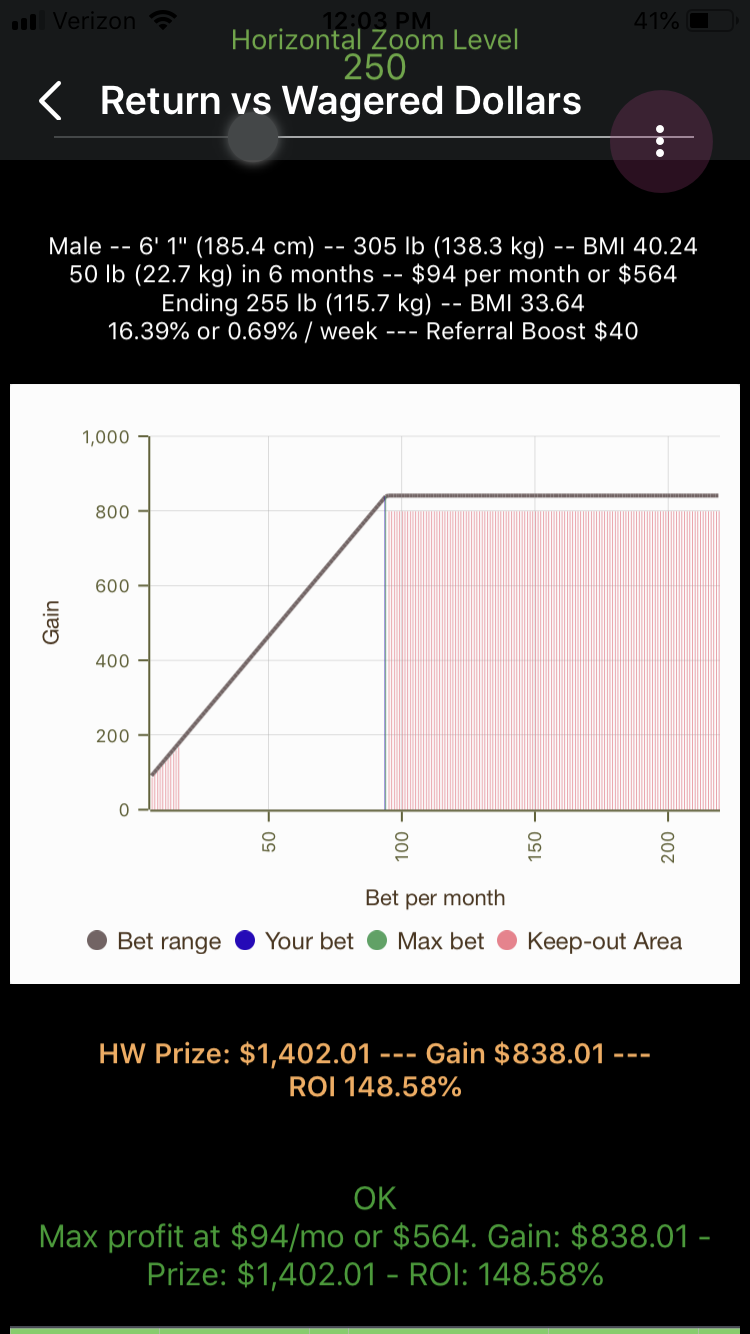

Note the increased ROI due to the referral bonus being added in. Since it’s a flat amount, overall ROI for the bets is large for small bets and tapers off as the bet increases:

The final step is to enter the Heathy Wage website—using the referral link—and sign up for the wager. Here’s the prize offer:
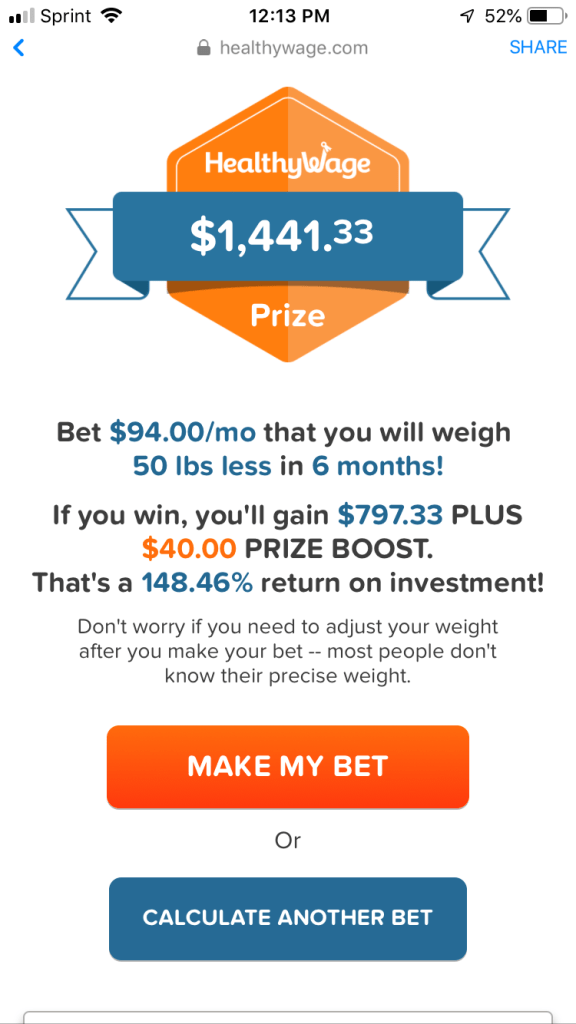
OK, this is an IT goof. The pre-referral gain is $798.01 in HWSim, which is a $0.68 error from Healthy Wage’s official calculator.
The prize, pre-referral, is $1,361.33 in Healthy Wage, versus $1,362.01 in HWSim—again, a $0.68 error. But it appears I had the $40 referral boost doubly applied in my screenshot. I should be getting boosted to $1,401.33 but the website gave me $1,441.33. In the end I probably wouldn’t get away with that when I sign up—but who knows!
Generally speaking, HWSim has more error with regular formula payouts than with triple-bonus formula payouts. That is because the precise ROI formula that Heathy Wage uses is very complicated and I haven’t figured it out fully yet through reverse engineering. I made some trend lines in Excel as part of my model, which approximates some things.
At lower ROIs, there is more error—but I consider that to be tolerable because small money is less exciting than big money.
In contrast, the triple-bonus formula is very simple, and HWSim confirms to the Healthy Wage calculator within a couple of pennies.
Next…
In a future post, I will consider increasing the weight pledge to drive up the ROI, so that more money can be wagered.
 Weight Betting Odds