
 Posted by
 Download HWSim on your smartphone here!
In a previous post, I looked at a hypothetical 305-pound man (6’-1”), looking to lose 50 pounds in 6 months on a HealthyWager, and uses HWSim to find the maximum profit point. HWSim calculated that maximum profit on this wager is just under $800, and is achieved with a wager of $94/month or $564, with a return on investment of 141%. With a $40 referral code, the prize is about $1,402. The Healthy Wage calculator is less than a dollar away from the HWSim calculation.
For this post, the man will consider pledging more weight in order to drive up return on investment as well as the maximum profit cap. He will attempt to trigger the more generous “triple-bonus” payout formula, which will result in an ROI of over 200%.
He starts with the 50-pound, 6 month scenario.
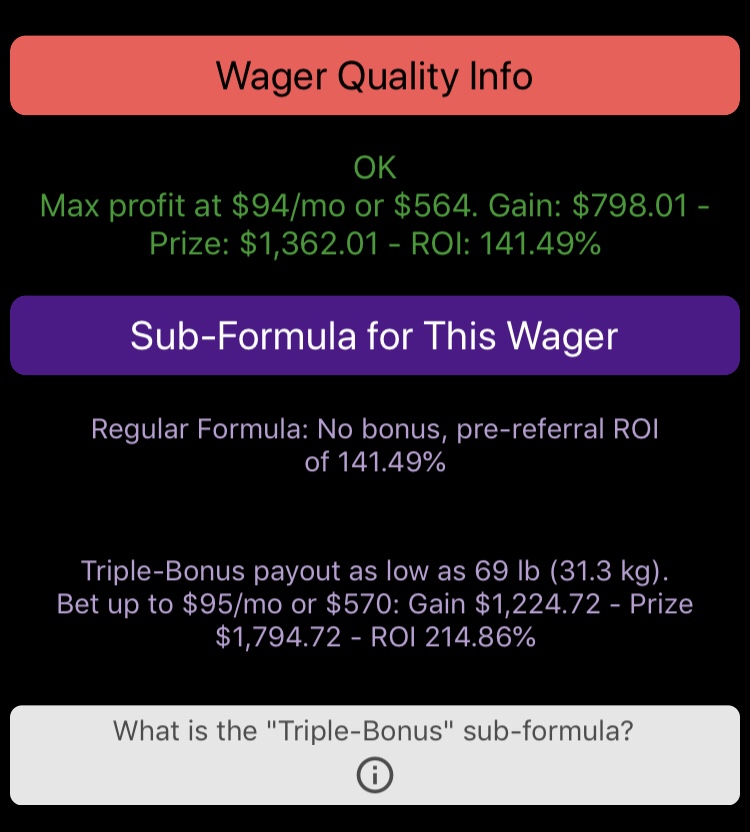
This indicates that an increase in pounds pledged by 19, to 69 pounds, will drive the ROI up to the point that the “regular” formula is replaced by the “triple-bonus” formula.
Generally, there is a linear relationship between pounds pledged and the logarithm of return on investment. Put another way, the step increase in ROI with each pound added gets slightly larger as the pounds accumulate.
But once this ROI reaches 194.12%—representing a near tripling of your bet—the formula governing payout switches over to one in which net gain is a relatively simple sum of two components.
The first component is equal to the amount you bet multiplied by 194.12%. This is the “triple” part of the triple-bonus—although it is not quite triple your bet.
The second is independent of bet amount—it is a certain dollar amount awarded for each of your pounds pledged, in excess of 10% of your body weight. This is the “bonus” part.
Check out how ROI changes with pledged pounds, at the $20/month or $120 betting level.
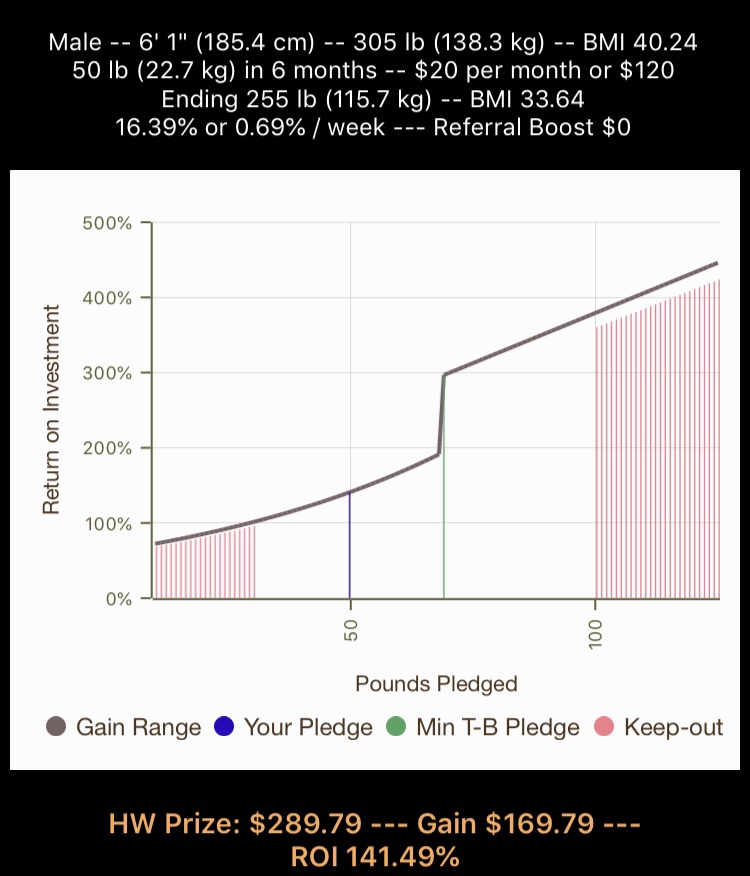
To the left of the green line—the regular formula payouts—ROI increases with pledged pounds, but the rate of increase picks up as the pledged pounds increase (moving from left to right).
At the green line—69 pounds—the payout model switches from regulator to triple-bonus. The jump you see in ROI is caused by the bonus kicking in. (For this man, that value is $3.20 times the number of pounds pledged in excess of 10% of the starting body weight of 305 lb. Thus: $3.20 * (69 – 0.1*30.5) or $123.20.)
To the right of the green line, the gain increases by $3.20 for every additional pound pledged. The ROI slope to the right of the green line is thus constant.
Here’s the data line for the 69-pound wager:


You can see the jump in payout when moving from 68 to 69 pounds.
However, doing this in 6 months is going to be tough. The rate of weekly weight loss is 0.98%. That is aggressive, although it can still be safe to do.
Losing 50 pounds in 6 months requires approximately 0.69% week-to-week loss. The man is happy with that speed, so he decides to lengthen the bet so that more weight can be lost over more time. He wants to see if the ROI will increase to the point where the triple-bonus formula will be triggered.
He first considers a 7-month bet. He scrolls upward and changes the time frame for the bet…
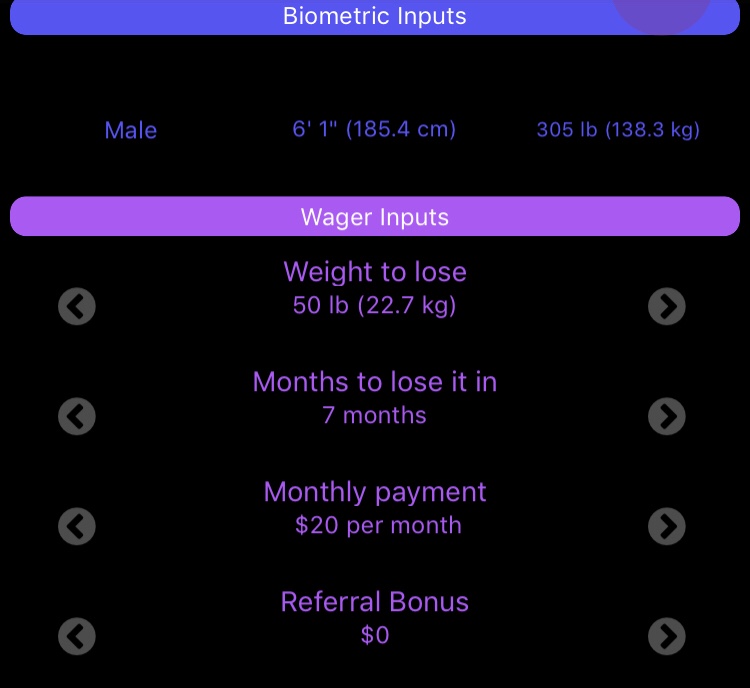
…and scrolls down to the table to see how much weight he would lose over 7 months at approximately a 0.69% week-to-week rate.


It’s 58 pounds. The ROI increases to about 164%—almost 5:3 odds. It’s better than 141%, but still in the regular formula range.
Extending to 8 months:


65 pounds, 187% return. It’s 15:8, but not quite triple-bonus territory. You can see that at 8 months, a 68 pound pledge will trigger the triple-bonus formula. (This is less than the 69 pounds required for a 6 month bet—in the regular formula, ROI goes up mildly with bet duration, all else being held equal.)
At 9 months…
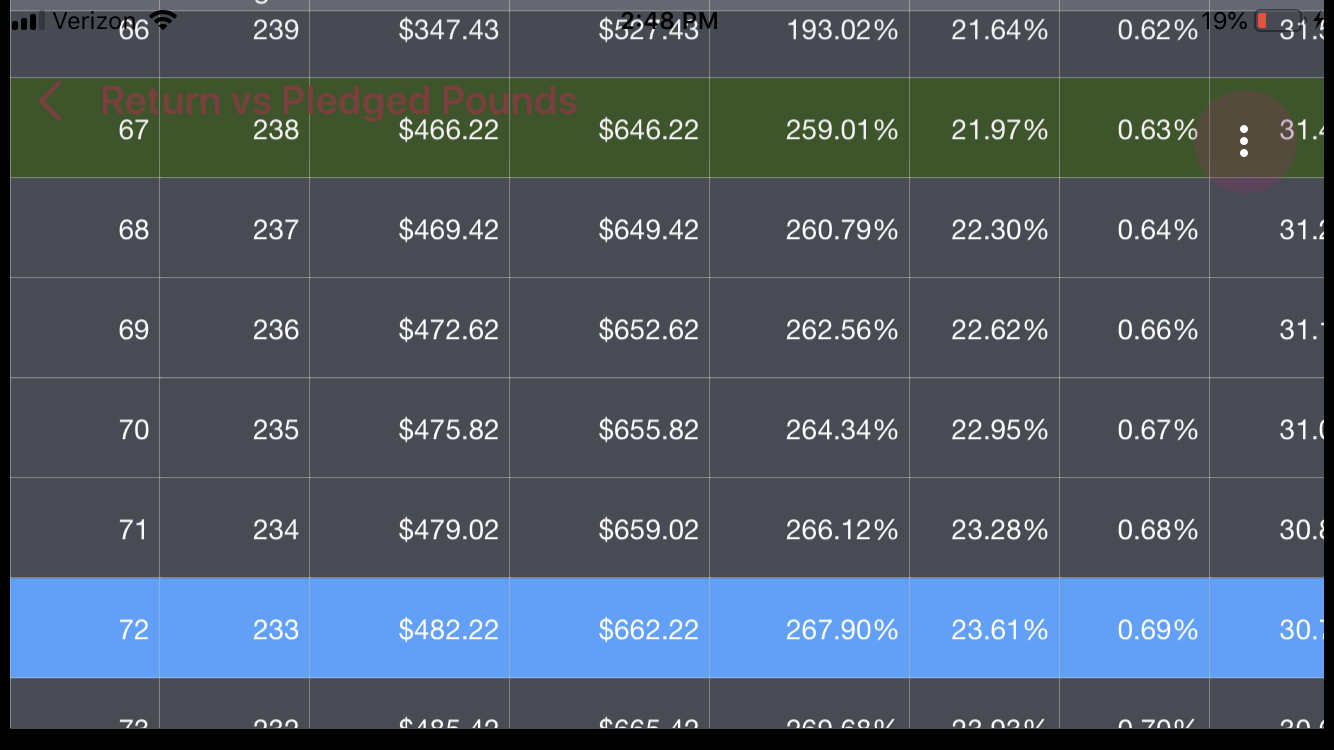
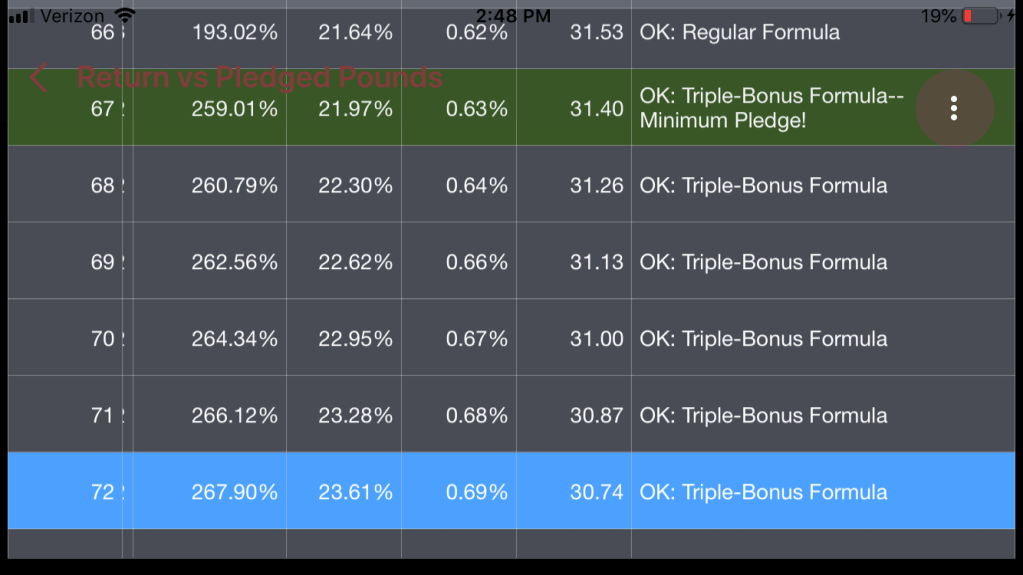
… a loss of 72 pounds is 0.69% week-to-week. This is a triple-bonus payout. With a bet of $20/month, or $180, the profit is $482.22, and the ROI is 268%. This is about 8:3.
But a pledge of 67 pounds, or 0.63% week-to-week, is enough to trigger the triple-bonus formula. The profit there is $466.22—only $16 less than with the 72-pound wager.
If the bet amount is increased, that $16 difference will remain the same. It’s a function of the bonus component of the triple-bonus profit: he’s only getting $3.20 extra for each of those 5 pounds over the 67. Thus, the man decides it is a worthwhile tradeoff to pledge to lose only 67 pounds and 0.63% week-to-week instead of 72 pounds and 0.69% week-to-week.
So how much should the man bet in order to max out on profit, for a 67-pound wager at 9 months?
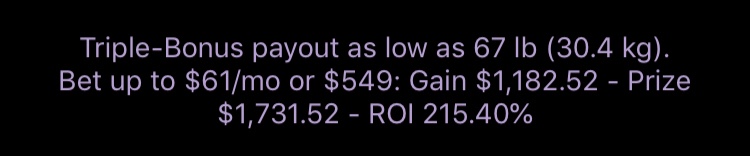
This message is immediately available when the 9-month duration is selected.
He then selects 67 pounds and $61/month:

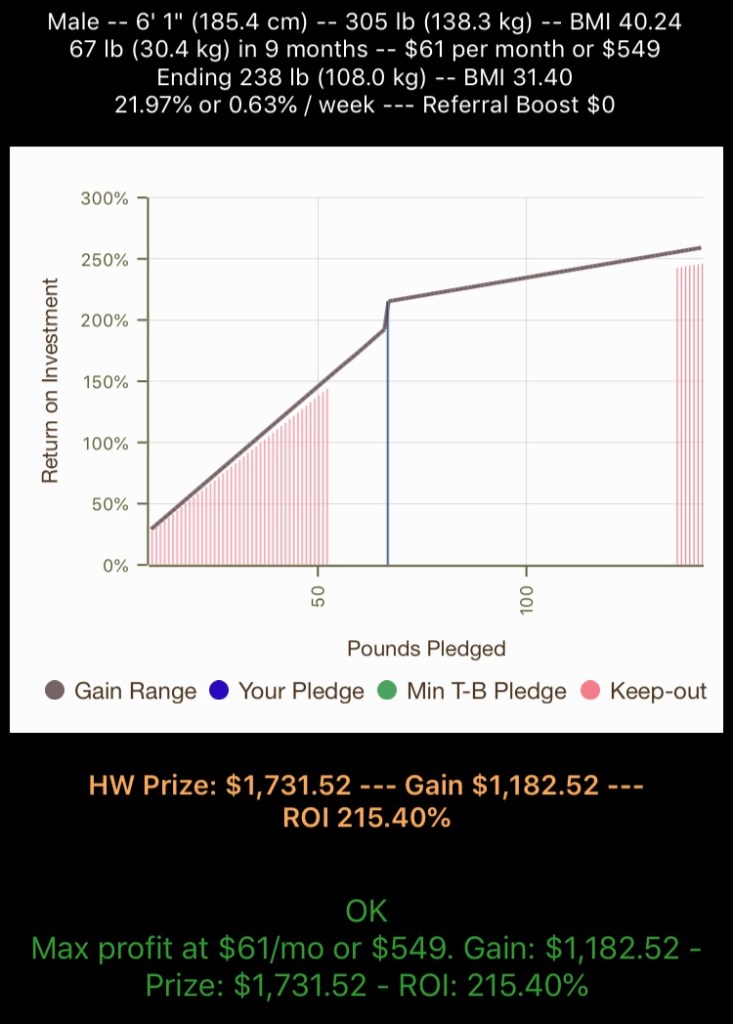
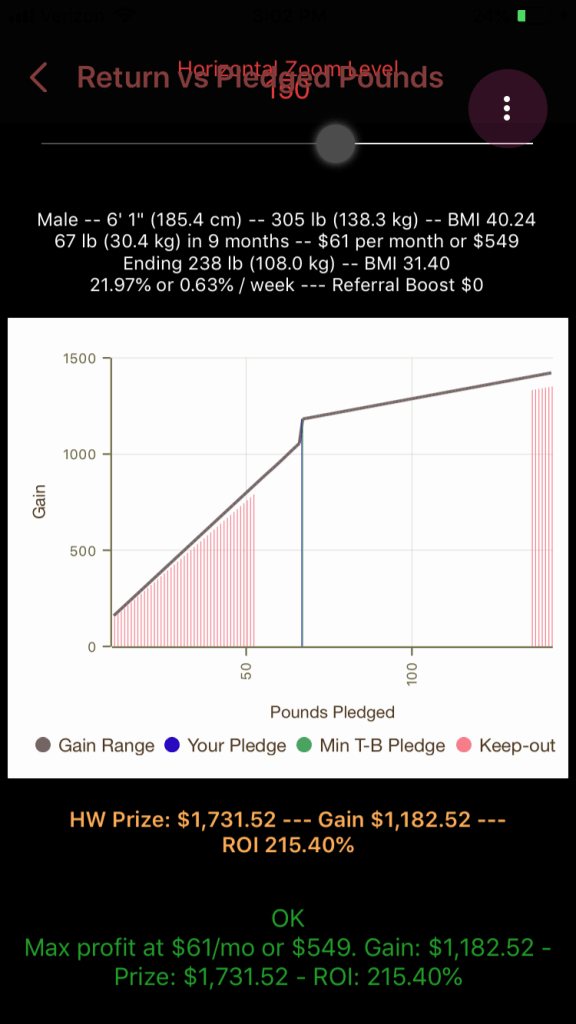

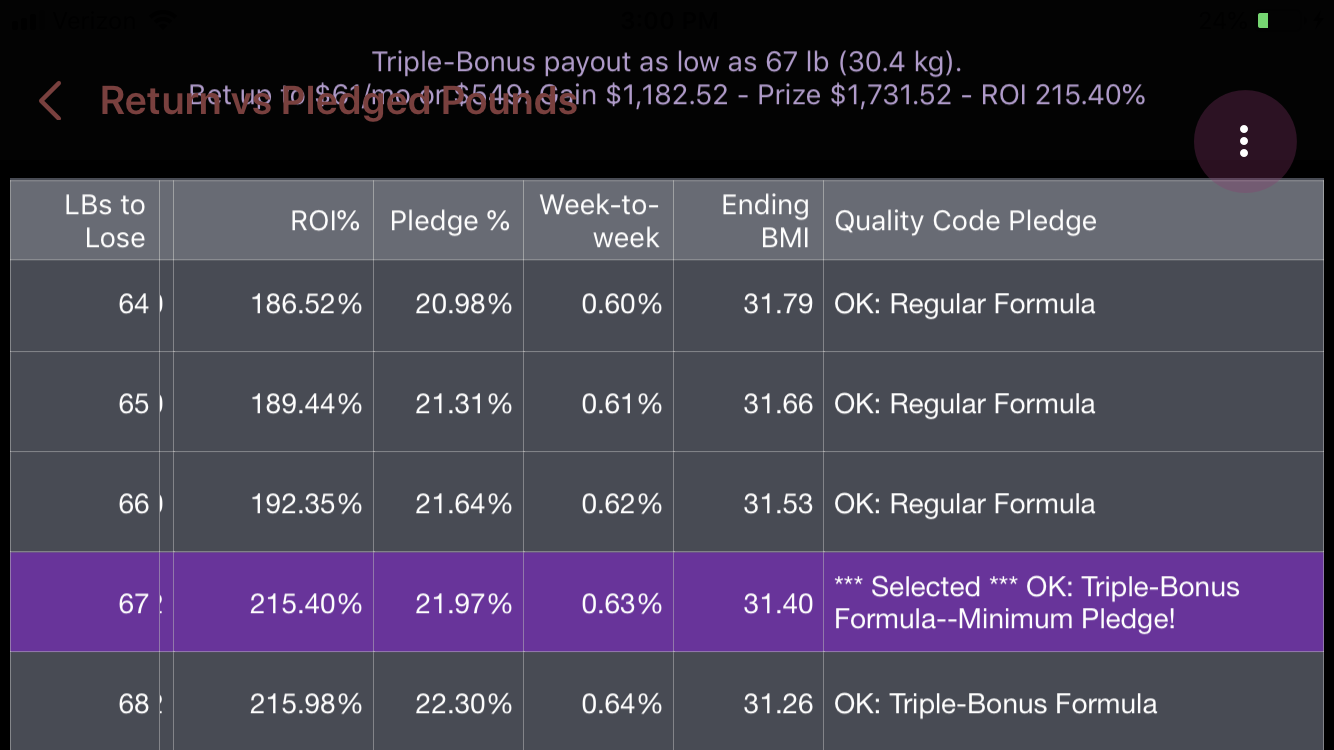
… and the profit is $1,182.52, prize $1,731.52, and ROI of 215.40%. This is better than tripling of a $549 bet.
In the Return vs Wagered Dollars page:
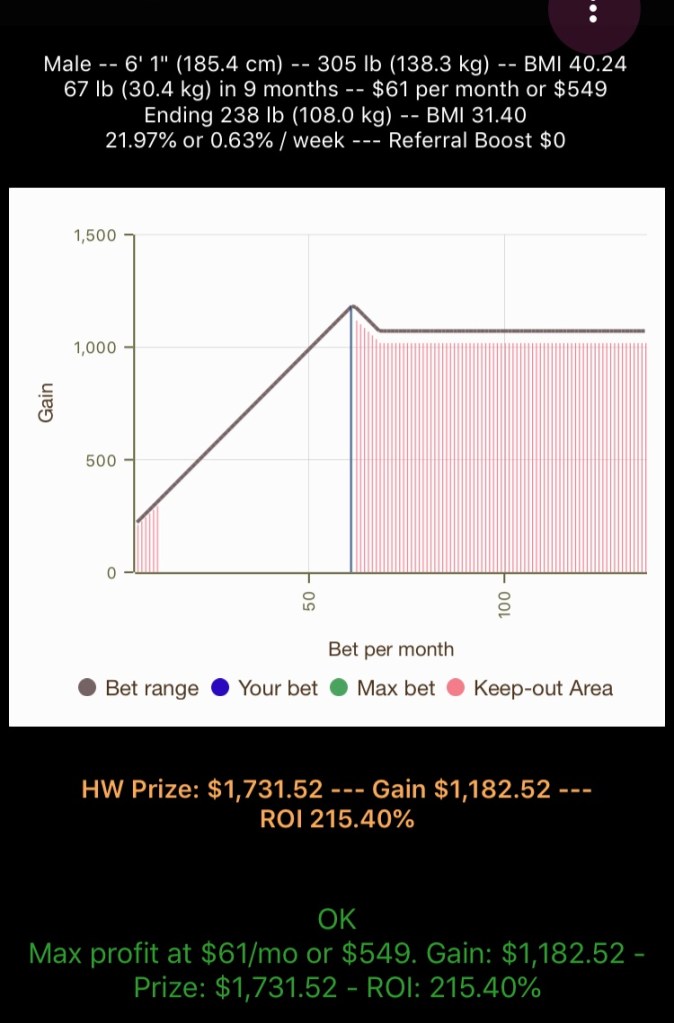
You can see that $61/month is the point at which maximum profit is achieved for a 67-pound, 9-month wager.
In the Healthy Wage site:

Ignore the issues with the prize boost getting added in. I have found that when I first do the query, I get the $40 added TWICE—the prize appears as $1,801.51. Then, when I do a new calculation, this query appears in history with a gain of $1,731.51—without any referral boost added at all.
What I really expect to see with a $40 boost is $1,771.51. But disregarding this referral mishandling in the Healthy Wage site, the HWSim app deviates from the Healthy Wage calculator by $0.01. One penny.
Coda
I really like these data tables that I have added. It is really cool to be able to sweep both bet amount and pounds-to-lose and see how the payout changes.
The horizontal zoom controls allow you to display only a few data points or a lot of them. It took some trickery in Excel as well as in OpenAsApp (the program I use to build and update the app quickly). But I think it is going to pay off.
 Weight Betting Odds