
 Posted by
 This post focuses on what is going on in Michigan, where the future of how we get out of this is going to depend on how well the federal and state governments agree or disagree about things.
First, some graphs form the IHME models. Each of these shows projections from four iterations:
- Original iteration with actual data through 3/24 (gray)
- Update with actual data through 4/8 (light blue)
- Update with actual data through 4/10 (dark blue)
- Update with actual data through 4/12 (red)
All of these are the mean (average) except where indicated. Minimum and maximum are also available in the IHME model data that has been published.


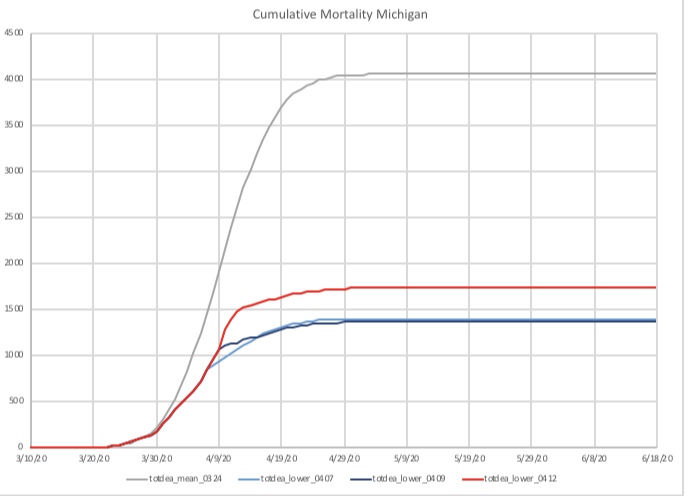
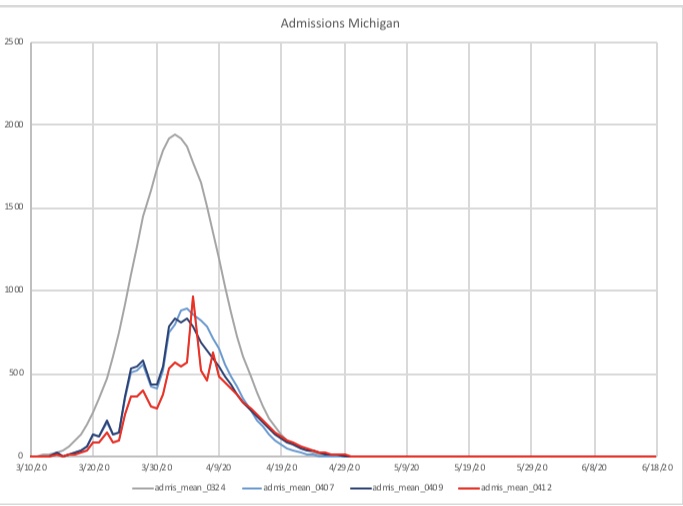


You can see that the model predictions were much more dire at the beginning than they are now.
As you may remember, Governor Whitmer had implemented a stay-at-home order starting 3/24, to last through 4/13. This order was considered in the first three iterations I am showing.
People can argue that this stay-at-home order was responsible for the migration of the model need to remember that the models have ALWAYS assumed that such an order would be in place until May 31.
From the history over the past 3 weeks, I would have to conclude that Michigan managed to bring the hospitalization overload down to a minimum, which is something to be proud of. The model was predicting that such mitigation would merely reduce the hospitalization crisis from gargantuan to huge; what really happened was that we reduced it from some unknown level (let’s say “huge”, more or less) to the mild level that we are at now.
On 4/9, Whitmer extended the stay-at-home until 4/30. But she also banned residence-to-residence travel and purchase of a complicated list of “non-essential” goods, such as garden seeds, tile, and paint. Whole sections of department stores were ordered shuttered.
While I understand the benefits of extending the period, I was distressed by the additional restrictions she imposed. The scientific rationale for these is lacking. They are adding little benefit to the effort of combating the disease while causing unnecessary problems that will result in more suffering and perhaps more mortality in the long run.
Whitmer is trying to restrict transmission of the disease as much as possible. This may reduce the case load and mortality in the short run. But she can’t stomp out the virus everywhere—it is going to come in, sooner or later. She could keep the state shut down all year long and the disease will come back into the state from any number of sources, because it is now all over the world.
People are going to get exposed to the virus at some point. Most healthy people will survive and become tempered. I think the best strategy for individuals is to delay getting the disease as long as possible, so that the greatest array of treatment options is available when you do get it.
But people can manage this themselves, without Mommie Gretchen telling them what to do or not do. The edicts don’t make much sense, collectively. In the end, people may avoid Covid-19, but suffer in some more mundane way.
But the data right now is looking better, and I am predicting that the stupider aspects of these edicts are going to be walked back. She’ll be forced to do it—the data will back her into a corner. If she holds out, a Trump card may be played.
Stay tuned!


What do you think of this article?
https://www.cnbc.com/2020/04/17/influential-covid-19-model-uses-flawed-methods-and-shouldnt-guide-us-policies-critics-say.html
LikeLike